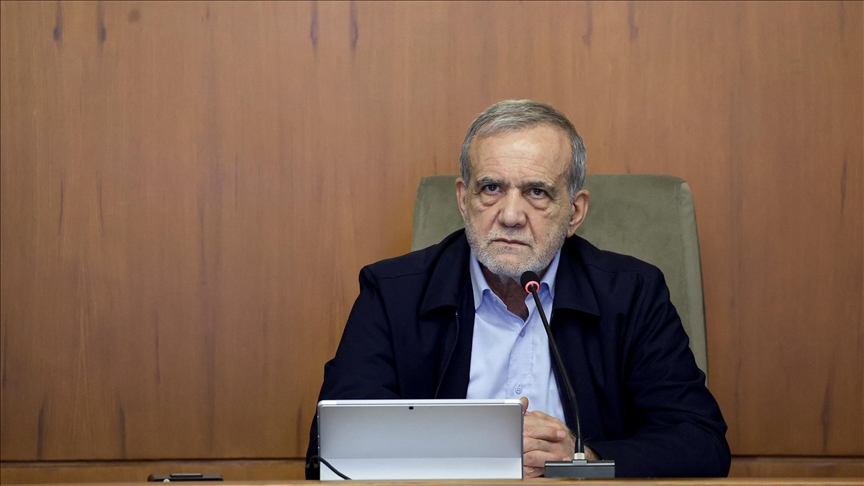
 Pezeshkian: ‘Iran Will Not Surrender to Bullies’
 Israeli Soldiers Enforce Closure of Al Aqsa
 1 in 7 Displaced in Lebanon – NRC
 Hormuz: End of an Era of Martime Dominance
 Gaza Faces Massive Dust Storm


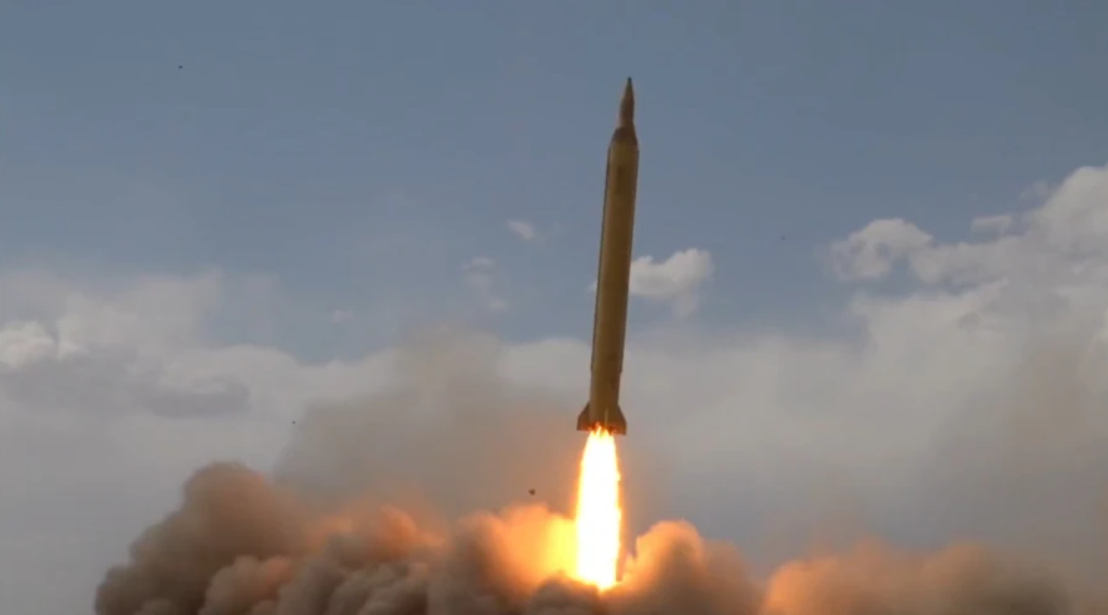
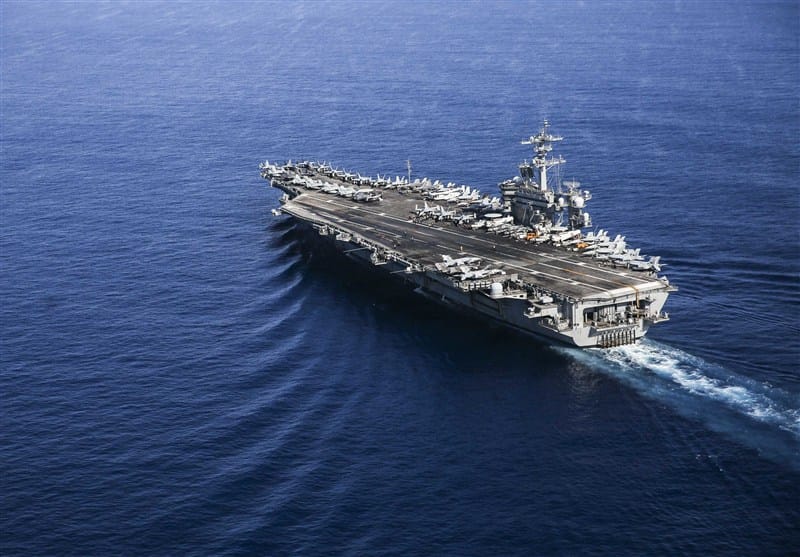
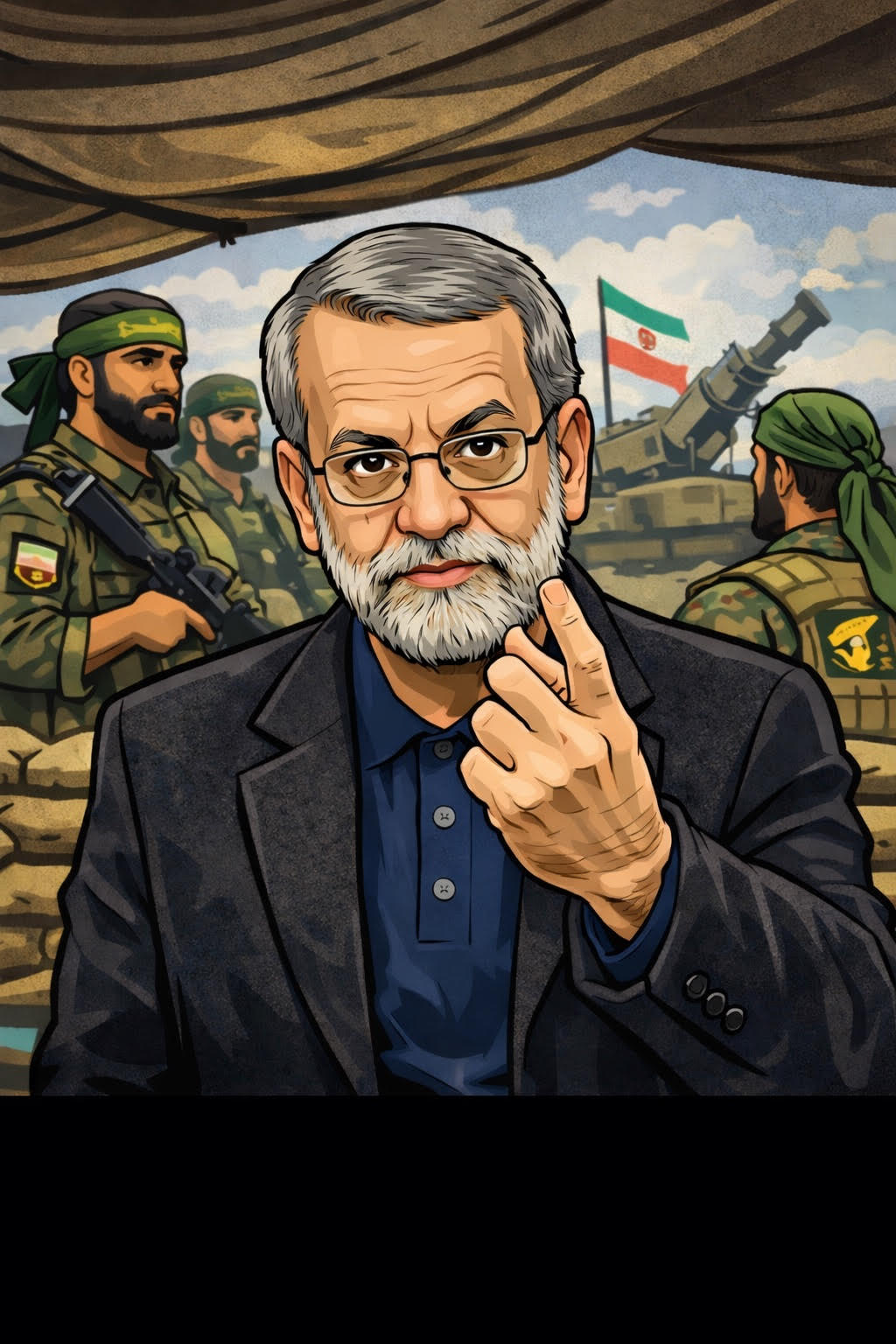
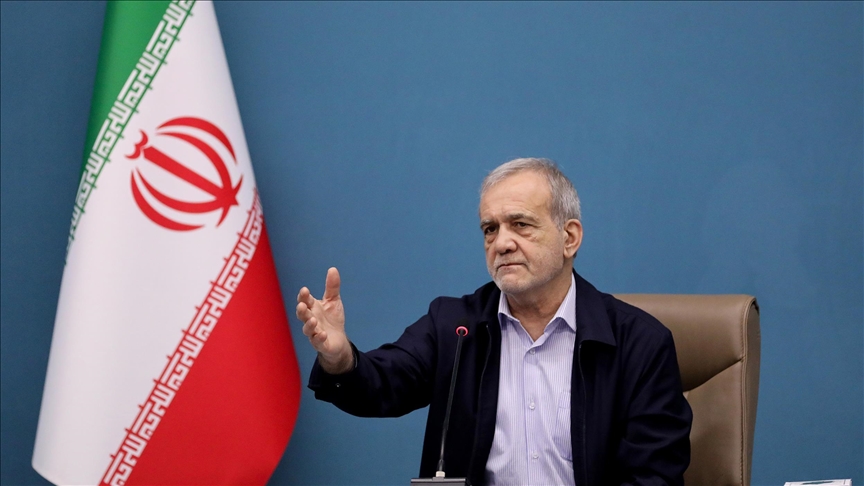
Pezeshkian: ‘Iran Will Not Surrender to Bullies’
 CrossFireArabia
- March 16, 2026
 CrossFireArabiaCrossFireArabiaCrossFireArabiaCrossFireArabiaCrossFireArabiaCrossFireArabiaCrossFireArabiaCrossFireArabiaCrossFireArabiaCrossFireArabiaCrossFireArabiaCrossFireArabiaCrossFireArabiaCrossFireArabiaCrossFireArabiaCrossFireArabiaCrossFireArabiaCrossFireArabiaCrossFireArabiaCrossFireArabiaCrossFireArabiaCrossFireArabiaCrossFireArabiaCrossFireArabiaCrossFireArabiaCrossFireArabiaCrossFireArabiaCrossFireArabiaCrossFireArabiaCrossFireArabiaCrossFireArabia
 Saleem Ayoub QunaCrossFireArabiaCrossFireArabiaCrossFireArabiaCrossFireArabiaCrossFireArabiaCrossFireArabiaCrossFireArabiaCrossFireArabiaCrossFireArabiaCrossFireArabiaCrossFireArabiaCrossFireArabiaCrossFireArabiaCrossFireArabiaCrossFireArabiaCrossFireArabiaCrossFireArabiaCrossFireArabiaCrossFireArabia
On Tuesday, Israeli National Security Council Chief Tzachi Hanegbi called for an investigation into the “catastrophic failure” of 7 October, 2023.
This was the first call by Hanegbi after he was dismissed by Israeli Prime Minister Benjamin Netanyahu. “Netanyahu informed me, today, of my dismissal,” he said.
“The catastrophic failure of 7 October must be investigated to learn lessons and help restore the trust that was shattered,” he added.
Hanegbi was one of the most prominent confidantes of war criminal Benjamin Netanyahu, but recent disagreements between the two over the management of the war on the Gaza Strip contributed to his dismissal.
Israeli reports indicated that disagreements between the two men escalated over core security issues, including Hanegbi’s opposition to the so-called “Gideon 2” operation to occupy Gaza City, his support for a “phased deal” for a prisoner exchange, and his rejection of the Israeli attack on Qatar.
The dispute reached its peak when Hanegbi did not accompany Netanyahu on his recent visit to Washington, amid reports of a heated confrontation between the two during a meeting that ended with Hanegbi angrily leaving Netanyahu’s office.
The decision is the latest in a series of dismissals and resignations from senior positions within the Israeli government and military following the “Al-Aqsa Flood” operation carried out by the Izz ad-Din al-Qassam Brigades, the military wing of Hamas, and resistance factions on October 7, 2023 as reported in the Arabic assabeel.
CrossFireArabia
The Americans, both the Biden and Trump administrations, gave the Israelis two years to destroy Hamas in Gaza. This is what the leader of the Palestinian National Initiative Dr Mustapha Al Barghouti started by saying. So for them the time was up came 7 October, 2025.
He maintained that it was because they couldn’t finish the job, the White House acted swiftly, stating enough is enough, the war on Gaza must end. What he said its true because today, the quest to end the war on the enclave and let the aid trucks in is an American initiative, who are almost dragging Israeli Prime Minister Benjamin Netanyahu forward who doesn’t want to end the war.
In a sharp analysis, the Palestinian politician said the Americans, especially President Donald Trump came to realize that the Israelis were not going to destroy Hamas despite the mass destruction of the Gaza Strip through mass weapons supplied by the United States. And that this is when the Trump administration decided to act and enforce the present, albeit fragile ceasefire between Tel Aviv and Hamas and according to him, ending the bloody, destructive, heinous war on Gaza.
But it was not for the lack of trying. When Trump entered the White House in January 2025, he then tried to sell the Rivieria Gaza idea to the region but he finally realized the Palestinian people of Gaza couldn’t be driven out of their homeland, even if it was just temporarily as he claimed and that there was going to be no way of parcelling them out to other countries.
Dr Barghouti pointed out Trump tried very hard talking to states like Indonesia, in the Arab world and those in Africa, seeking all sorts of pressure to persuade them to take the Gazans. But after much diplomatic chitchat, he realized the Palestinians weren’t for moving despite the fact that 250,000 of them were killed and/or injured at the hands of the Israeli army and the horrific mass destruction of their homeland.
This proves that the idea the Palestinian population can be ethnically cleansed – much talk about that in the past two years of the genocide – was a non-starter and that 1948 when hundreds of thousands of Palestinians were driven off their land by Israeli militias and terror gangs was not going to be repeated. Dr Barghouti added the last onslaught on Gaza has proved that ethnic cleansing has become a “closed chapter”.
And he added Trump and his team led by Steve Witkoff and Gerard Kushner became aware of that, and that is when it was decided to push for a ceasefire to save Israel from itself. Barghouti putted this way: Trump realized many countries of the world were turning against Israel because of its murderous actions on Gaza and its mass displacement and starvation of the people of the enclave and to let Netanyahu have his own way by refusing to stop the war would be detrimental to US interests in the region.
Thus when Israel tried to re-start the war on Gaza last Monday – and a week into the ceasefire – when two of its soldiers were killed in Rafah through lone fighters and which Hamas immediately disavowed, the Trump administration played down the incident in the interest of maintaining the ceasefire accord reached at the beginning of October, 2025.
Trump first dispatched Witkoff and Kushner to Israel with Vice-president JD Vance who followed on a two-day visit in an effort to keep tempers low. Their visit to Israel today is sending a message that the US administration wants the ceasefire to be followed through in the interest of Trump’s 20-point peace plan for the Middle East.
CrossFireArabia
More than 20,000 Palestinian students were killed and over 31,000 injured in Israeli attacks in the Gaza Strip and West Bank since October 2023, official figures showed on Tuesday.
In a statement, the Palestinian Education Ministry said that 19,910 students in Gaza and 148 others in the occupied West Bank lost their lives in attacks by the Israeli army.
Israeli army fire also injured 30,097 students in Gaza and 1,042 others in the West Bank, it added.
According to the ministry, 1,037 teachers and school administrative staff were killed, 4,740 others injured, and more than 228 detained in both areas since the start of the Israeli war in Gaza in October 2023 according to Anadolu.
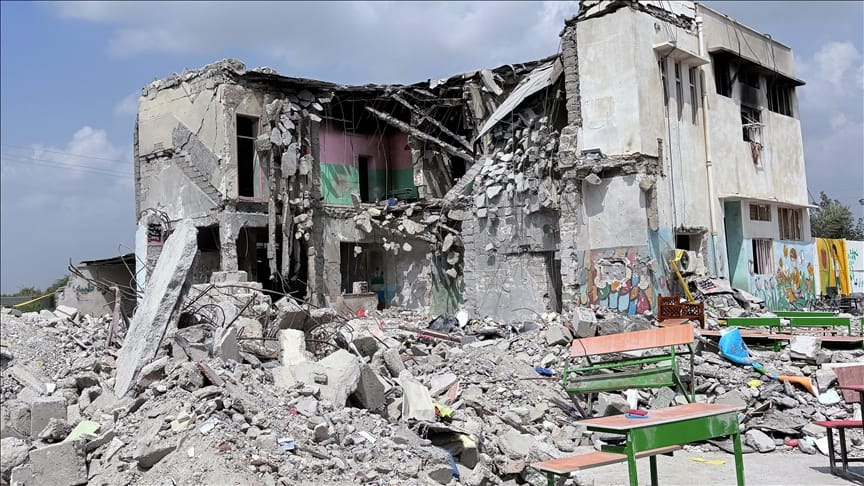
The ministry said Israeli attacks completely destroyed 179 schools and 63 university buildings in Gaza, and partially damaged 118 governmental schools and 100 UN-run schools.
Data also showed that 30 schools were completely removed from the official register of the ministry, including the students and the teachers.
In the West Bank, two schools were fully destroyed in Hebron and Tubas, and eight university buildings were partially damaged in repeated Israeli raids, the ministry said.
Since October 2023, the Israeli genocidal war has killed over 68,200 people and injured more than 170,300 in Gaza, according to the Gaza Health Ministry.
The occupied West Bank also witnessed a sharp rise in attacks over the same period, with at least 1,056 Palestinians killed, around 10,300 injured, and more than 20,000, including 1,600 children, detained, according to official Palestinian figures.
CrossFireArabia
The UN on Monday said it was encouraged by renewed Gaza ceasefire commitments, warning that recent violence risked undermining fragile progress, as recovery efforts – including a large-scale rubble removal project – slowly gain momentum across the war-ravaged enclave.
“We are encouraged that the parties have reaffirmed their commitments to implementing the ceasefire in Gaza and commend the steadfast efforts of the mediators,” said UN Spokesperson Stéphane Dujarric at the regular news briefing in New York.
“We do, however, remain concerned by all acts of violence in Gaza and the reported attacks and strikes that took place yesterday.”
Mr. Dujarric urged all sides to honour their obligations and avoid any action that could lead to renewed hostilities, reiterating the Secretary-General’s call for the release of the remains of all deceased hostages.
Over the weekend, Humanitarian Affairs chief Tom Fletcher wrapped up a visit to Gaza, where he met aid workers and inspected UN-supported projects, including a child nutrition centre, a hospital and a road clearance operation.
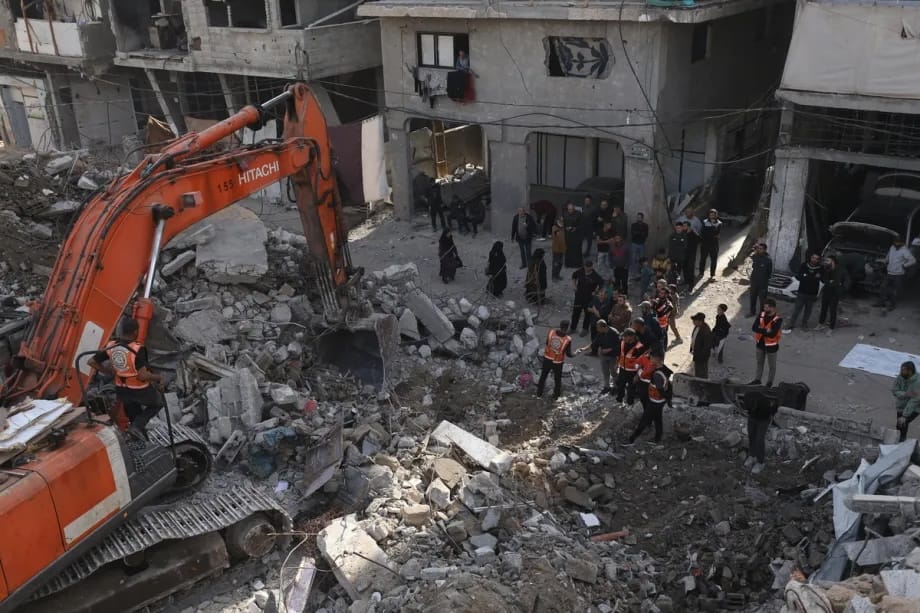
In Gaza City, the UN Development Programme (UNDP) has begun a major debris removal operation – the first phase of a comprehensive debris management plan aimed at restoring access to essential services such as hospitals and schools.
“Rubble represents a major challenge in Gaza, where the estimated amount is between 55 and 60 million tonnes,” said Jaco Cilliers, UNDP Representative in Palestine.
The UN agency taking the vital first step by clearing roads and recycling materials to pave new access routes and temporary facilities.
Dozens of diggers and other vehicles have been deployed along Al-Jalaa Street, where UNDP says it is working around the clock to open roads that have been blocked for months.
“This is a very arduous process and will take many years to complete,” Mr. Cilliers cautioned.
UN humanitarians also reported progress in aid delivery under the ceasefire, with the UN agency assisting Palestine refugees (UNRWA) expanding temporary learning spaces and partners resuming food parcel distributions in Deir al-Balah and Khan Younis.
“Over the weekend, we along with our partners continued to collect aid from the Kerem Shalom/Karem Abu Salem and Kissufim crossings. This included post-partum and hygiene kits, medical supplies, fuel, water and food,” Mr. Dujarric said.
He added that on Sunday, for the first time, Israeli authorities allowed the UN to deploy monitors at the Kissufim crossing.
“This is of course a welcome development, as it provides us with much-needed visibility into that segment of the pipeline,” Mr. Dujarric added according to UN News.
CrossFireArabia
Euro-Med Monitor condemns Israel’s systematic destruction of projects, infrastructure, and housing units built with full or partial funding from the European Commission and EU member states, whether through Palestinian civil society organisations or UN agencies, particularly the United Nations Relief and Works Agency for Palestine Refugees (UNRWA), during Israel’s two-year genocide in the Gaza Strip.
Israel’s systematic destruction targets not only physical assets but also vital systems that ensure basic rights to water, health, education, and adequate housing. Such targeting constitutes a flagrant violation of Israel’s obligations as an occupying power under international humanitarian law.
Initial damage documented by the Euro-Med Monitor team includes water desalination facilities, hospitals, clinics, health centres, schools, and housing units constructed under EU-funded reconstruction programmes.
The disruption of desalination facilities and water and sanitation networks directly violates individuals’ right to safe water and sanitation. The destruction of schools deprives children of their right to education. Meanwhile, the demolition of homes has left thousands of families homeless and forcibly displaced.
The most notable examples include severe damage to a desalination facility in the northern Gaza Strip, built with European Union funding through UNICEF’s water programmes, and another facility in Deir al-Balah, established under the EU’s Water Programme for the Palestinian Territories (Union for the Mediterranean initiative) and implemented by UNICEF.
UN reports indicate that the vast majority of schools in the Gaza Strip have been damaged or rendered inoperative, including UNRWA schools, which receive substantial funding from the European Union and are among the most severely affected facilities.
The EU has long funded Gaza’s water and sanitation sectors, including the central desalination programme, short-term low-volume (STLV) units, and connection and distribution works. Subsequent assessments show that water and sanitation assets, such as coastal wells, transmission lines, reservoirs, and pumping stations, have sustained extensive damage, directly affecting EU-funded projects in this vital sector.
These deliberate attacks cause immense human suffering and constitute direct targeting of civilian infrastructure protected under the Geneva Conventions and the principles of international and humanitarian law.
The EU’s reluctance to take decisive action to stop Israel’s two-year genocide in the Gaza Strip, coupled with its reliance on rhetorical measures, has emboldened Israel to intensify practices that erode any basis for peace and justice. This occurs as Europe remains Israel’s main trading partner and key supplier of weapons, while also serving as the primary market for Israeli arms exports.
Through their actions and inaction, European governments continue to provide political and legal cover for Israel’s violations, despite official assessments, reports, and public statements by European officials acknowledging serious and systematic breaches of international humanitarian law, some amounting to genocide.
The EU’s continued silence on Israel’s policies reflects a disregard for the legal, political, and moral obligations it has long affirmed in its official statements. Under Article 2 of the EU–Israel Association Agreement, respect for human rights is a fundamental condition of bilateral relations.
Although internal European reviews have repeatedly found strong and clear evidence of serious violations of international humanitarian law by Israel, neither the European Commission, the Council, nor the Parliament has activated any available corrective mechanisms, such as suspending trade privileges, freezing cooperation frameworks, or triggering the dispute resolution mechanism. Maintaining relations in this manner effectively enables Israeli violations and constitutes a clear breach of the legal and moral obligations set out in the EU’s own contractual framework.
This European failure to use available pressure tools sends a dangerous message: the destruction of European-funded assets and the terrorising of civilians can continue without political or legal consequence. It undermines the EU’s credibility and weakens its claim to uphold a rules-based international order.
Israel must be required to provide full financial compensation for every European-funded project destroyed or damaged, including replacement and temporary operating costs. An official European investigation should be launched, with a detailed public report published on the losses of EU-funded assets in Gaza and the identification of those responsible. Euro-Med Monitor also calls for the prosecution of civilian and military officials involved in issuing or executing such orders before the competent authorities, and for full support of relevant international legal proceedings.
Compensation in this context is not merely a financial assessment of losses; it signifies acknowledgement of responsibility for internationally unlawful acts and a crucial step toward restoring Palestinians’ access to essential services crippled by repeated bombing, bulldozing, and targeting.
The EU must compel Israel to provide full and immediate compensation for all damage to projects and infrastructure financed by European public funds, whether directly through the Commission and member states or indirectly through UNRWA, UN agencies, and partner organisations.
Furthermore, the EU must move immediately from moral condemnation to concrete action by activating available enforcement tools, foremost among them suspending the partnership agreement with Israel and supporting international and European investigations to ensure the prosecution of those responsible for targeting protected civilian property and obstructing humanitarian aid.
Euro-Med Monitor stresses the need to maintain investment in Palestinian development and avoid punishing the population by cutting relief and service programmes under the pretext of potential destruction, as this effectively punishes victims twice. Efforts should instead focus on holding the aggressor accountable through comprehensive economic, political, and legal pressure, rather than reducing support for essential civilian infrastructure.
Urgent funding is needed for early recovery and rehabilitation programmes in key sectors, particularly water, health, education, and housing, with priority given to projects that ensure service sustainability and the protection of related facilities.