Spiralling Catastrophe: 1 in 3 Not Eaten in Days

United Nations agencies welcomed, Sunday, Israel’s pledge to implement daily humanitarian pauses in its military operations in Gaza, aimed at easing the flow of desperately needed aid into and across the devastated enclave.

But as starvation tightens its grip and “children are dying before our eyes,” UN officials and aid workers warn that the measures fall far short of the much-needed ceasefire and unfettered aid access that could help stem the spiralling humanitarian catastrophe.

“Welcome announcement of humanitarian pauses in Gaza to allow our aid through,” UN Emergency Relief Coordinator Tom Fletcher said on X. “In contact with our teams on the ground who will do all we can to reach as many starving people as we can in this window.”

In a statement later issued later by the UN Office for the Coordination of Humanitarian Affairs, or OCHA, which Mr. Fletcher heads up, he added that some movement restrictions appear to have been eased today, with initial reports indicating that over 100 truckloads were collected.

“This is progress, but vast amounts of aid are needed to stave off famine and a catastrophic health crisis. Across the UN agencies and humanitarian community, we are mobilized to save as many lives as we can, he said, but called for “sustained action, and fast”, including quicker clearances for convoys going to the crossing and dispatching into Gaza.

“Ultimately of course we don’t just need a pause – we need a permanent ceasefire,” stated Mr. Fletcher, who emphasized: “The world is calling for this lifesaving aid to get through. We won’t stop working for that.”

Also reacting via X, UNICEF said: “This is an opportunity to begin to reverse this catastrophe and save lives.”

According to the agency, since the collapse of the ceasefire between Israel and Hamas in March, children have been trapped in a nightmare and deprived of the basics to survive.

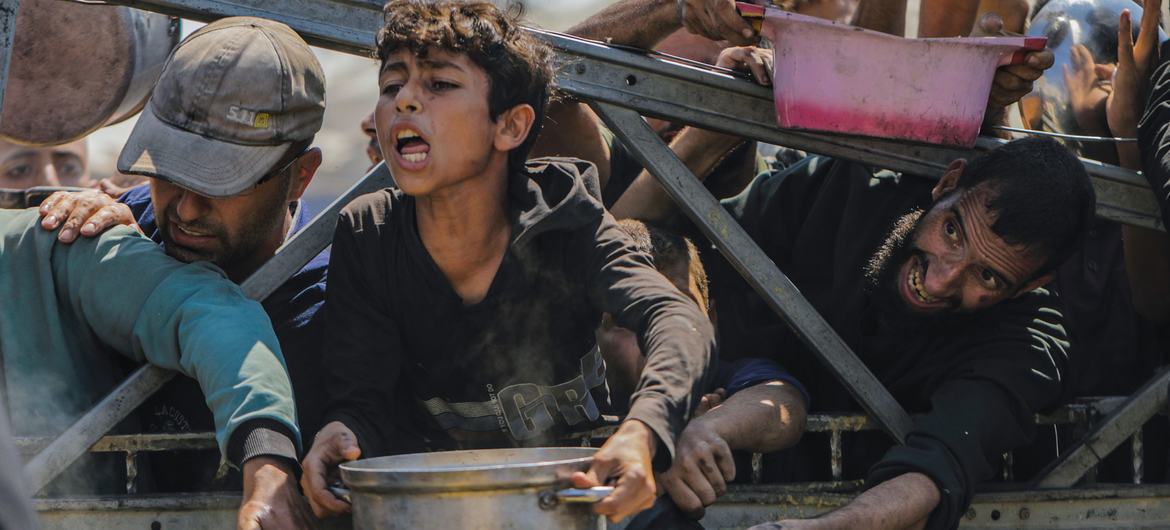
“The entire population of over two million people in Gaza is severely food insecure. One out of every three people has not eaten for days, and 80 per cent of all reported deaths by starvation are children,” the agency continued.

UNICEF emphasized that while it has never stopped delivering, “we can do a lot more if additional designated humanitarian corridors are created to facilitate the movement of our convoys – as well as commercial trucks, which are essential.”

‘A lifeline – if upheld and expanded’

The UN World Food Programme (WFP) also welcomed Israel’s announcement and its intent to open designated corridors for aid convoys in Gaza, “where hunger has reached catastrophic levels.”

With nearly half a million people facing famine-like conditions and a third of the population going days without food, WFP said in a press statement that the measures could offer a lifeline – if upheld and expanded.

Despite recent deliveries, including 350 truckloads last week, aid workers continue to face extreme risks and logistical hurdles. WFP said it has enough food stockpiled or en route to feed Gaza’s 2.1 million residents for three months, but without a ceasefire and consistent access, the scale of need far outpaces current efforts.

“An agreed ceasefire is the only way to reach everyone,” the agency stressed, calling for predictable and safe conditions to prevent further loss of life.

‘An entirely preventable crisis’

At the same time, the UN World Health Organization (WHO) warned that malnutrition in Gaza is spiralling out of control, with a sharp rise in deaths – most of them in July – marking what it calls a “dangerous trajectory.”

Of the 74 malnutrition-related deaths recorded this year, 63 occurred this month alone, including 24 children under five. Many died before reaching medical care, their bodies showing signs of severe wasting.

“This crisis is entirely preventable,” WHO said in a press release, citing the deliberate obstruction of aid for the mounting toll.

Children are bearing the brunt. Over 5,000 children have already been treated for malnutrition in July, many with the most life-threatening form. But Gaza’s four specialized treatment centers are overwhelmed, running low on fuel and supplies, and staffed by exhausted health workers.

“The health system is on the brink,” WHO warned, as disease spreads rapidly through communities with no clean water or sanitation.

The crisis is also devastating pregnant and breastfeeding women, over 40 per cent of whom are now severely malnourished. And it’s not just hunger that’s killing people—it’s the desperate search for food, according to WHO.

Since late May, more than 1,000 people have been killed and over 7,000 injured while trying to access aid. WHO is calling for an immediate ceasefire and a sustained surge of diverse, nutritious food and medical supplies.

“This flow must remain consistent and unhindered,” the agency said, urging protection for civilians, health workers, and humanitarian operations.

‘The world will judge this conference’

Looking ahead to the High-Level Conference on Palestine set to open on Monday at UN Headquarters in New York, the UN High Commissioner for Human Rights issued a strong call for immediate action to end Israel’s unlawful occupation and the ongoing devastation in Gaza.

“Countries that fail to use their leverage may be complicit in international crimes,” Volker Türk warned in a statement, urging governments to seize the moment for concrete measures that pressure Israel to halt the carnage and recommit to a two-state solution.

The UN rights chief described Gaza as a “dystopian landscape of deadly attacks and total destruction,” where children are starving and families are being killed in their search for food. The militarized aid distribution system, supported by the US and Israel, is failing to meet the scale of need.

“We can never forget that more than 300 of our own colleagues have been killed,” he added.

Moreover, in the occupied West Bank, violence by Israeli forces and settlers continues unabated, with homes demolished and water supplies cut off.

Mr. Türk reiterated condemnation of the 7 October attacks by Hamas but emphasized that the scale of suffering inflicted on Palestinians since then cannot be justified.

Calling for an immediate, permanent ceasefire, the release of hostages and detainees, and a massive surge in humanitarian aid, he concluded:

“The people of the world will judge this Conference on what it delivers.”

UN News

Continue reading
‘One Killed Every 12 Minutes’

New Islamic Relief analysis of UN data1 reveals July is now the deadliest month in Gaza for 18 months, with Israel killing one person every 12 minutes as it accelerates the systematic targeting and starvation of civilians.

An average of 119 Palestinians are being killed daily so far in July – the highest rate since January 2024. More than 401 Palestinians a day are being wounded, the highest figure since December 2023, whilst doctors report 19 people, mostly children, died from starvation in just one day this week – victims not just of violence, but of a deliberate policy of deprivation and man-made famine.

The killings have accelerated since Israel imposed its new heavily militarised food distribution scheme in late-June, with almost daily massacres of starving people as they try to collect food. The Israeli blockade has systematically impeded humanitarian aid, forcing people into starvation and shooting those who seek aid. Hundreds of desperate civilians have been gunned down, with many of the wounded piled onto donkey carts as ambulances are prevented from reaching them.

Waseem Ahmad, Chief Executive of Islamic Relief Worldwide, says world leaders must urgently take action to stop the escalating slaughter:

“The rate of killing is accelerating every day that world leaders fail to act. We are witnessing people massacred just for trying to get food, water or medicine. We’re seeing babies and young children starve to death because Israel is blocking humanitarian aid. We’re seeing starving families ordered to leave their homes, then bombed in the tents where they are told to shelter. Israel is using starvation as a weapon of war, shutting down the humanitarian system then forcing people to militarised death traps.

“There is no excuse for inaction when five more people are being killed every single hour. Every minute costs lives. Gaza’s entire society is being killed – sons, daughters, parents, medics, teachers, artists, aid workers, journalists, entrepreneurs, engineers, poets, farmers. No one is spared.

“This dehumanisation and normalisation of suffering must not be allowed to continue. Governments that fail to act are complicit. More words of condemnation and concern are not enough – we urgently need world leaders to take meaningful action to pressure Israel to stop the killing and allow humanitarian aid to reach those in need. That means ending all arms sales, suspending trade agreements and banning produce from illegal Israeli settlements. Only increased and sustained international pressure can stop this catastrophe and save lives.”

International governments have a moral and legal duty to act to prevent genocide, in line with the ruling of the International Court of Justice. They must flatly refuse the militarised distribution system and demand the restoration of the UN-coordinated humanitarian response, in line with humanitarian principles and international law.

Most of the casualties are civilians and at least 30% of people killed throughout the crisis are children. UNICEF says that 28 children are being killed every day and the global Protection Cluster warned last week that 10 children a day in Gaza are losing a limb, with a surge in amputations due to missile strikes and artillery fire.

In total, around 9% of Gaza’s entire pre-war population have now been killed or wounded, with over 59,000 people dead and over 140,000 wounded – many with life-changing injuries such as loss of limbs.

Notes

  • 1 Between 1—20 July in Gaza, at least 2,382 Palestinians have been killed and 8,030 injured, according to figures collated by the UN-coordinated Health Cluster in the Occupied Palestinian Territory. This is already the highest number of fatalities in a calendar month since March 2024 when 2,617 Palestinians were killed at an average of 84 people killed a day. The average number of people killed so far in July 2025 is 119 every day, the highest since January 2024 when 5,041 people were killed at an average of 162 per day. The average number of people wounded per day so far in July is 401, which is the highest since December 2023 when 667 people a day were wounded.
  • Islamic Relief has worked in the Occupied Palestinian Territory since 1997. During the current crisis our Palestinian staff and partners have provided vital aid to more than 600,000 people, including food, water, healthcare and education.

Reliefweb

Continue reading
AFP Sounds Alarm Bells About Starving Journalists

Agence France-Presse (AFP) expressed fear its correspondents in the Gaza Strip may starve to death amid the catastrophic conditions of suffering Palestinians in the Strip amidst the Israeli war.

The agency said in a statement on its X platform: “We have been working with a freelance copywriter, three photographers, and six freelance videographers in the Gaza Strip since the departure of its permanent journalists in early 2024.”

The agency, founded in 1944, added: “Today, they, along with a few others, are the only ones still covering what is happening inside the Gaza Strip, after international media outlets were banned from entering the territory for nearly two years.”

The French news agency explained Bashar, who worked with the agency since 2010, “started as a field assistant, then as a freelance photographer, and since 2024 has become the main photographer.” The agency added on Saturday, July 19, he managed to post a message on Facebook saying: “I no longer have the strength to work in the media. My body is thin and I can’t work anymore.”

Bashar, 30, works in conditions similar to those of all Gazans, moving from one refugee camp to another depending on the Israeli bombardment.

“For more than a year, he has been living in abject poverty and continues his work amid grave risks.” AFP added “hygiene has become a major problem for him. He suffers from severe diarrheal illnesses, and since February, he has been living in the ruins of his home in Gaza City with his mother, his four brothers and sisters, and the family of one of his brothers.”

The Agency continued: “His house is devoid of furniture, electricity, and water, and he lives on what some of his relatives provide. On Sunday, he reported that his older brother had fallen due to… Hunger.”

Although these journalists receive a monthly salary from the French agency, it barely covers, or does not cover, the skyrocketing market prices. The banking system is broken, and the intermediary who transfers funds from foreign accounts to the Gaza Strip takes a commission of nearly 40%.

The agency explains that it “cannot provide its team with equipment or even enough fuel to travel to do their work,” noting that “traveling by car is tantamount to risking becoming a target for Israeli airstrikes.” Therefore, its correspondents travel “on foot or on donkey carts.”

Ahlam, for her part, confirms that “the biggest problem she faces is the lack of food and water.” The journalist, who lives in the southern Gaza Strip, adds: “Every time I leave the tent to cover an event, conduct an interview, or document an incident, I don’t know if I’ll return alive.”

We see them collapsing.

The agency says: “They are young and their strength is fading, and most of them no longer have the physical ability to move within the Gaza Strip to do their work. Their calls for help, torn apart, have become daily.”

She adds: “A few days ago, we realized from their text messages that their strength was no longer sufficient, that they were no longer even able to deliver news to us, so let them tell you the truth from there.”

Bashar is quoted as writing, Sunday: “For the first time, I feel defeated. More than three years of hell, and we no longer find the words to explain to the world that we live daily between death and hunger. I hope that Mr. Macron will help me escape this hell.”

His colleague Ahlam says: “I am trying to continue my work, to give a voice to the people, to document the truth despite all attempts to silence it.” Resistance is not an option, but a necessity.

More than 225 journalists have been martyred in Gaza since the beginning of the Israeli aggression on October 7, 2023, as part of the Israeli occupation’s plans, using all means at its disposal, to obscure the truth, change the image, and prevent foreign journalists from entering Gaza.

Since its founding in 1944, Agence France-Presse, despite its permanent presence in conflict zones, has not witnessed the death of any of its employees from starvation.

The Ministry of Health in Gaza confirmed that the Israeli starvation policy has led to the deaths of more than 900 Palestinians—including 71 children—due to hunger and malnutrition, in addition to 6,000 wounded among those seeking a livelihood since the beginning of the Israeli war of extermination on the Gaza Strip.

Palestinian and international organizations have warned that the Gaza Strip is currently experiencing the worst stages of famine as a result of the Israeli starvation policy as reported in Jo24.

Continue reading
Gaza: A Starvation Nightmare

UN humanitarian workers said that alarming reports of UN staff members in the Gaza Strip fainting from hunger and exhaustion over the past 48 hours have heightened fears for the lives of the population in the besieged enclave.

“Doctors, nurses, journalists, and humanitarian workers, including UNRWA staff, are suffering from hunger… fainting from hunger and exhaustion while carrying out their duties,” said Juliette Touma, Director of Communications and Public Information for the United Nations Relief and Works Agency for Palestine Refugees (UNRWA).

Speaking from Amman, Touma emphasized that the search for food has “become as deadly as the bombing.”

More than 1,000 Palestinians Killed


This development comes as the Office of the High Commissioner for Human Rights announced that more than 1,000 Palestinians have been killed by the Israeli army while trying to access food in Gaza since the so-called Gaza Humanitarian Facility began operating on 27 May.

“As of 21 July, we have recorded 1,054 people killed in Gaza while trying to access food; 766 of them near GHF sites, and 288 near UN and other humanitarian aid convoys,” said UNHCR spokesperson Thamin Al-Khaitan.

The US- and Israeli-backed organization began operating in the Strip on May 27, bypassing the UN and other established NGOs.

“Aid work is not for mercenaries”


“GHF’s so-called distribution scheme is a sadistic death trap, where snipers fire indiscriminately into crowds, as if they have been given a license to kill,” Ms. Touma said.

Quoting UNRWA Commissioner-General Philippe Lazzarini, Ms. Touma described the scheme as “a mass hunt for people with complete impunity.” She added: “This cannot be the new normal. Humanitarian assistance is not the work of mercenaries.”

The UNRWA spokesperson emphasized that the United Nations and its humanitarian partners have the expertise, experience, and resources available to provide safe, dignified, and large-scale assistance. “We have proven this time and again during the recent ceasefire,” she said.

Famine-like conditions
Living conditions in the Gaza Strip have reached a new low, with prices for basic goods increasing by nearly 4,000%. Gazans, who have lost their homes and been displaced multiple times, are left without income and are completely deprived of essentials.

Ms. Touma highlighted the testimony of a colleague on the ground who had to walk for hours to buy a bag of lentils and some flour, paying nearly $200 for it.

The World Food Programme has confirmed that a quarter of Gaza’s population is facing famine-like conditions, with nearly 100,000 women and children suffering from severe acute malnutrition and in need of urgent treatment.

Everyday staples such as diapers are scarce and expensive, costing around $3 each. Mothers have resorted to using plastic bags instead, while one father said he “had to cut up one of his last shirts to give his daughter sanitary pads,” Ms. Touma said.

Ms. Touma emphasized, “UNRWA has stockpiles of hygiene supplies, including baby and adult diapers, waiting outside the gates of Gaza.” She emphasized that the agency has 6,000 trucks loaded with food, medicine, and hygiene supplies waiting in Egypt and Jordan for entry into the Strip.

Urgent appeal for a ceasefire


She reiterated the UN’s calls for “an agreement that would achieve a ceasefire, release the hostages, and allow the regular flow of humanitarian supplies into Gaza under UN management, including UNRWA.”

For his part, World Health Organization spokesperson Tarik Jasarevic said that humanitarian operations in the Strip are being pushed into “an ever-shrinking space.” In a briefing to journalists in Geneva, he condemned three attacks on Monday on a building housing the organization’s staff in Deir al-Balah, central Gaza, as well as “the mistreatment of those present and the destruction of its main warehouse.”

“Staff and their families, including children, were exposed to grave danger and trauma after the airstrikes caused a fire and extensive damage,” said Mr. Jasarevic, adding that the Israeli military entered the building, “forcing women and children to evacuate on foot” toward the coastal area of Mawasi amidst intense fighting.

UN staff member detained…searched at gunpoint


A WHO spokesperson said that staff and their family members were “handcuffed, stripped, and subjected to immediate interrogation and searches at gunpoint.” Two staff members and two family members were also arrested. While three were later released, one WHO staff member remains in detention for unknown reasons.

Mr. Jasarevic called for the release of the detained staff member, emphasizing that “no one should be detained without charge or due process.”

Mr. Jasarevic added that the recent evacuation order for the area had affected many WHO buildings and weakened its field presence, “paralyzing efforts to maintain a collapsed health system and putting survival beyond the reach of more than two million people.”

According to health authorities in Gaza, approximately 1,500 health workers have been killed in the Strip since the war began in October 2023. Mr. Jasarevic said that approximately 94% of all health facilities have been damaged, and that half of Gaza’s hospitals are “completely non-functional.”

He emphasized that “the opportunity to prevent loss of life and reverse the massive damage to the health system is closing by the day.”

A Nightmare That Must End


UN High Commissioner for Human Rights Volker Türk described the nightmare facing the people of Gaza as worsening following the latest Israeli evacuation orders, followed by intensified attacks on southwest Deir al-Balah, which “added further misery to the suffering of starving Palestinians.”

He warned in a statement that the risk of unlawful killings and other serious violations of international humanitarian law is extremely high, “given the concentration of civilians in the area and the means and methods of warfare used by Israel to date.”

He continued: “Homes have already been destroyed, and thousands have been forced to flee the area once again. Their only option is to go to the ever-shrinking areas of Gaza, where hundreds of thousands are forced to congregate, making any attempt to deliver humanitarian aid difficult. Even these areas are not safe. I remind Israel that the permanent displacement of people living under its occupation would constitute an unlawful transfer, a war crime, and, under certain circumstances, may also constitute a crime against humanity.”

The High Commissioner said that Israel, as the occupying power, must ensure the provision of food, medicine, and other supplies to the population, and must immediately and unconditionally allow humanitarian aid to enter and be distributed to all those in need. He added: “Instead of launching round after round of new military attacks, the killing, destruction, and widespread violations of international law must stop immediately. More and more countries are joining the calls to extricate us from this nightmare.”

UN News

Continue reading
UNRWA: ‘Israel is Starving 1 Million Children’

The UN agency for Palestinian refugees (UNRWA) on Sunday once again accused Israeli authorities of using starvation as a weapon of war against the civilian population of Gaza.

In a statement on X, UNRWA said: “The Israeli Authorities are starving civilians in Gaza. Among them are 1 million children.”

It renewed its urgent call for the lifting of Israel’s ongoing siege, saying: “Lift the siege: allow UNRWA to bring in food and medicines,” as reported in Anadolu.

Despite international legal obligations to protect civilians and allow the delivery of aid, Israel has maintained a total siege on Gaza since March 2, bombing convoys, blocking border crossings, and targeting aid distribution points, actions that have been widely condemned as collective punishment and potential war crimes.

According to Gaza’s Health Ministry, dozens of children have already died from starvation and dehydration, while hundreds of thousands more are at risk due to widespread food insecurity and the collapse of healthcare services.

On Saturday alone, Israeli strikes killed at least 136 Palestinians, including 38 individuals waiting for aid and three children who died from severe malnutrition, Palestinian official sources reported.

Israel has killed nearly 59,000 Palestinians, most of them women and children, in Gaza since October 2023. The relentless bombing has destroyed the enclave, almost collapsed the health system, and created famine-like conditions.

Continue reading