Diving in a War Zone

By Jing Zhang

When US and Israeli forces launched strikes on Iran on 28 February, triggering one of the most serious geopolitical crises in years, the Strait of Hormuz – a narrow channel just 34 kilometres wide at its narrowest point – became a global flashpoint overnight.

Iran closed the waterway to foreign shipping, attacking merchant vessels and cutting off around 20 per cent of the world’s seaborne oil trade. Some 20,000 seafarers were stranded in the Persian Gulf. The UN Secretary-General called for an immediate ceasefire.

Beneath all of it, the fish kept swimming.

Back in the water

Three Chinese divers based in the United Arab Emirates (UAE) – diving instructor Rui Li, freediver Shanshan Du and technical diver Jie Zhang – had been locked out of the water for weeks by the coastal closure. When a ceasefire allowed limited access in mid-April, they went straight back in.

World Oceans Day, marked each year on 8 June, carries the theme this year of Reimagining the Relationship Between Humans and the Ocean. For these three, that reimagining is anything but abstract.

“We were actually a little worried before setting off,” says Du, who dived the narrowest stretch between the UAE and Oman on 18 April, just days after the UN welcomed Iran’s announcement that the strait would be open to commercial vessels during the ceasefire. 

“But after more than two months, we all felt it was fantastic to be able to dive again. We encountered a large group of dolphins. There was none of the war-torn atmosphere I had imagined – only peace and beauty before my eyes.”

Zhang, who dived the area as recently as last week, describes coral diversity she has rarely encountered elsewhere – soft and hard corals varying with the topography, and sea turtles gathered in such numbers they evoked a nature reserve.

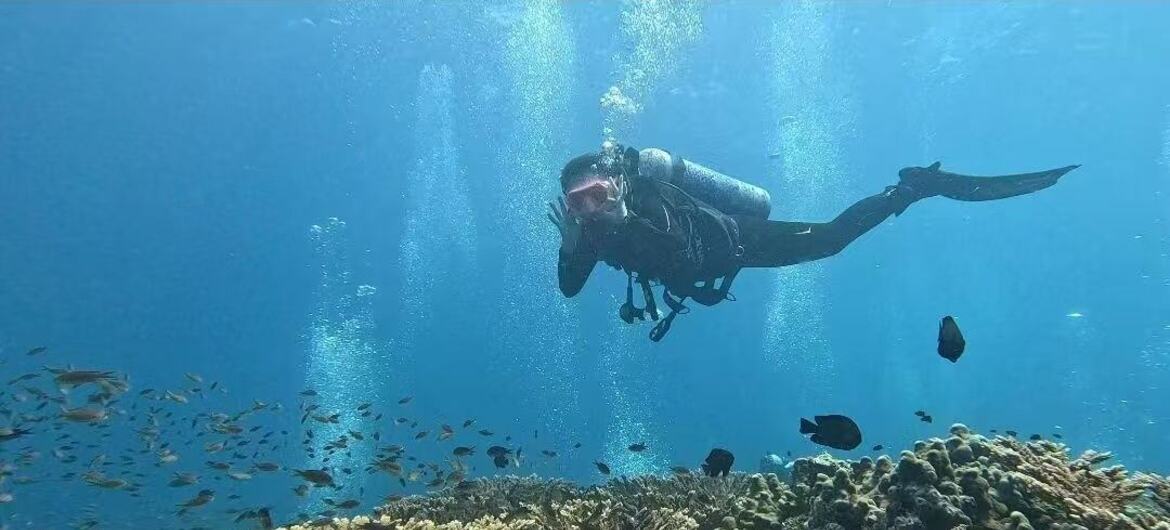
A person in a scuba diving suit and mask makes a peace sign against the ocean and blue sky.
Courtesy of Jie Zhang. Jie Zhang is back from the depths, feeling the warmth of the sun.

Troubling signs

She also noticed something more troubling. “I saw more white debris on the seabed than before,” she says, uncertain of its origin. And when she and her companions followed dolphins near the eastern side of the strait, the water around the animals was streaked with green algae, oil fumes and floating rubbish. 

“I recalled that when I used to chase dolphins, the water was blue. Seeing this scene with my own eyes is still very heartbreaking.”

Li is careful to hold both realities at once. The strait is not the world’s most biodiverse marine zone, he notes, but its complex topography sustains coral reefs of unusual variety – formations “as white as silver needles” alongside colonies “as purple as pine forests” – as well as seahorses, whale sharks and species rarely seen elsewhere.

He describes witnessing a boat captain who, unable to dive and with no other means of communication, could reliably find a pod of dolphins that seemed to recognise him. “We would greet each other and then go our separate ways,” Li says. “This place is truly magical.”

A wide bay with deep blue water, bordered by arid, rocky mountains and a small coastal settlement on the right.
©Jie Zhang Overlooking the Strait of Hormuz from the Musandam Peninsula, Oman.

Potential catastrophe

Yet he is also acutely aware of what armed conflict can do to such a place. An attack on oil storage facilities, he points out, could be catastrophic for marine life. “Many marine organisms are small and vulnerable. A single attack could be enough to wipe out some amazing species that have never been seen by humans.”

Zhang frames the underwater world’s vulnerability in blunt terms. “No one can speak for the underwater ecosystem  – fish can’t speak, and neither can large animals. 

“We dump all the disputes, wars and pollution on land onto the ocean, ignoring the fact that the ocean has no good self-protection capabilities and can only bear all the conflicts and damage caused by human activities.”

Diving has quietly dissolved certain certainties for all three. “Underwater, the ocean has no borders,” says Zhang. “Ocean currents and schools of fish move freely. When whale sharks cruise, they follow fixed routes through different countries – they are free. Humanity should share this blue world instead of tearing it apart with disputes.”

A person in a wetsuit and goggles floats in the ocean, adjusting their mask with both hands.
©Jie Zhang Rui Li makes a heart gesture to his dive buddy on the water’s surface, which also stands for “OK” in diving hand signal terms.

Mother ocean

Li reaches for a different metaphor – warmer, and perhaps more honest about the limits of human agency. The relationship between people and the sea, he suggests, is something like that between a child and a parent: the ocean sustains us, nurtures us, occasionally punishes us. 

“We have grown old enough to want to protect it, he says, yet what we can actually do remains small. “Our parents are still quietly waiting for us, helping us, and continuing to nurture us.”

Du, diving in a country where people of dozens of nationalities converge, has found that underwater, borders feel beside the point. Communication happens through gesture alone. “Because of this hobby, and because of the ocean, it has created a wonderful environment for us.”

The conflicts raging above the surface have not ended. Talks between Washington and Tehran remain fragile, conditions volatile. But 71 per cent of the Earth is ocean – and, as Li says to anyone who has yet to see it: come and touch the refreshing water whenever you can.

A school of sharks swimming in deep blue ocean water.
©Jie Zhang Madivaru Corner in the Maldives is a world-class dive site. Grey reef sharks and white-tip reef sharks are its permanent residents.

UN News

Continue reading
Memorizing The 1967 War Defeat!

By Dr Khairi Janbek

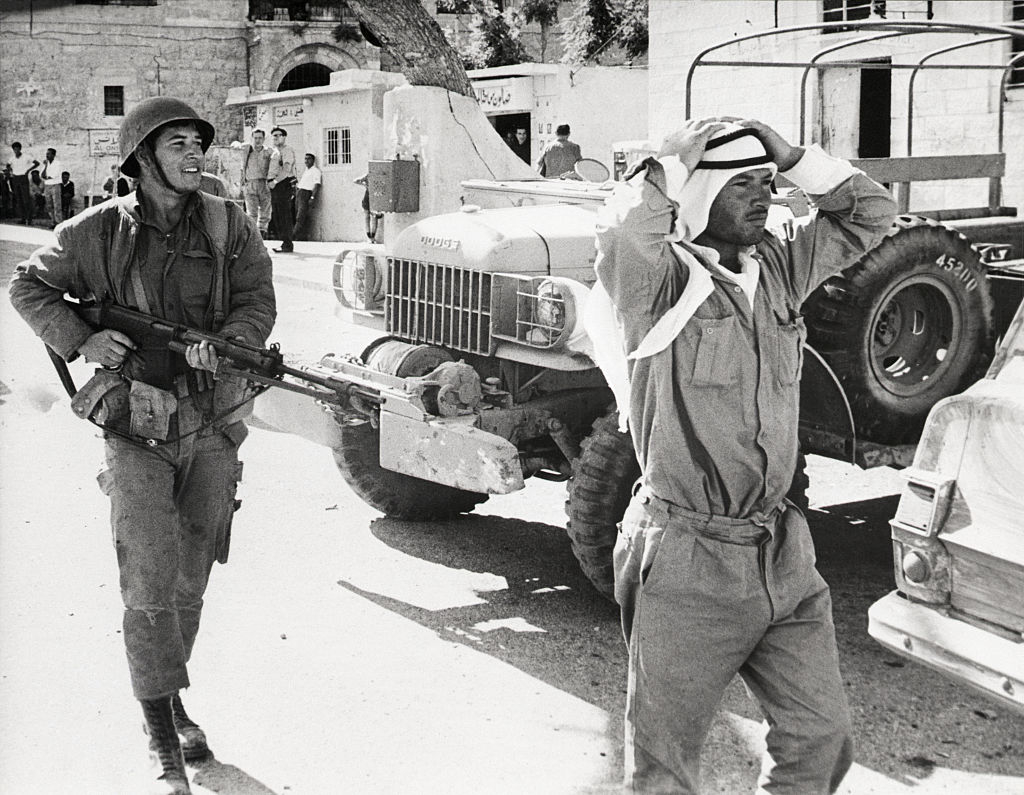
What can one say about the defeat of 1967 war, more than what the experts, the memoirs, and the active participants in it have said and written already, save from the eyes and ears of a child; for after all one was a child at the time and one must admit that growing up with defeat did have profound effect on one’s developing personality.

As it happened, in fact we were on a family holiday driving to Turkey when we heard the first actions in the war. By the time we crossed Damascus towards the north, the car radio was blasting with the advances made by the Arab armies on the path towards liberating Palestine.

However, by the time we reached an area close to the Syrian-Turkish border somewhere near Jabla in Syria, we discovered the the border was closed on the Syrian side and people including my late father were stuck around the big radio in the small roadside hotel talking about the destruction of the Israeli military forces, and the remarks that in a couple of days, Israel will cease to exist,

But low and behold, after a few days and by the time the border was opened, Egypt had lost Sinai, Syria, the Golan Heights, and Jordan the West Bank and Jerusalem; the jewel in the crown.

The car was tense, and for the first time I was disappointed, not because of the news of defeat rather, rather because I was no longer the centre of attraction for the family. As we entered Iskenderun in Turkey, a couple of young men crossing the streets, seeing our car number plate in Arabic, spat on the ground and said in Turkish; Pis Arap, meaning dirty Arab.

I didn’t undrestand Turkish at the time, until my father smiled bitterly and said, so we have just become dirty Arabs. In the small hotel in Iskenderun owned by a generous Armenian family, they brought us their transistor which could catch Syrian broadcasts and heard my father saying Nasser has resigned, and I was wondering how could he do that. For me, Nasser’s image was a cross between a king and an idol football player.

By the time we reached Ankara, it was all over. We were nothing in the eyes of the Turks at the time, but lying impotent Arabs. As the years passed, maturity set in as a strong slap in the face, with my childhood’s main scar left inside me, engulfing me with doubt, and disbelief, not only regarding what I now hear but also in what I see: with Arab politics to me, becoming just a mixture of cynicism, blatant lies, and regimes self-preservation.

The disaster from top to bottom was, unqualified military officers in Egypt, only accustomed to internal security and privileges were punching above their weight and carrying ranks which were above their undrestanding of warfare. Their ignorance was stark obvious when they knew about the attack and opted for absorbing the first blow before counter-attacking, not knowing they’ll have nothing left to counter with.

Jordan was squeezed between the hammer and the anvil diplomatically, though there were voices among the statesmen at the time urging not to participate in the impending whilst recognizing the perils, yet the decision to participate in the war and opening the Jordanian couldn’t be avoided because first of all the belief in Nasser’s victory held sway among the people, and secondly, to imagine an Arab defeat would not spare Jordan who will be blamed for this defeat due to the lack of giving support in the war.

In the case of Syria, how could an army in which the first officer who wakes up before the others and carries out a coup d’état, fight a war; and how could an army in which a general has to walk behind the coup d’état lower ranks whom are only concerned about preserving their own hold on power, conduct warfare? In fact the fall of the Golan Heights was declared by the Syria representative in the UN, 36 hours before it actually fell. And why was this? All in aid for withdrawing the army to protect Damascus.

Has anything changed? Everything has changed so that nothing changes!

Dr Janbek is a Jordanian writer based in Paris, France

Continue reading
Thousands Flee as Israel Threatens to Bomb Beirut

As hostilities escalate in Lebanon despite a recent ceasefire extension, the United Nations continues to push for peace and support displaced civilians by providing food, protection and other assistance.

Thousands of people fled the southern suburbs of the capital, Beirut, on Monday after Israeli announced that it will carry out renewed strikes targeting Hezbollah militants sheltered there. 

“Families are leaving by car, motorcycle, and on foot, carrying essentials,” the UN refugee agency, UNHCRtweeted. Many others are returning to shelters and “fear and uncertainty are mounting.” 

The UN reiterated that civilians and civilian infrastructures must not be targeted.  

“We urge all actors to respect the cessation of hostilities and avoid further escalation. We condemn all the loss of civilian lives,” UN Spokesperson Stéphane Dujarric told journalists in New York.

He underscored the need for a diplomatic solution to end the cycle of violence.

High stakes, heavy cost 

The development unfolded as the UN Security Council in New York prepared to hold an emergency session on Monday afternoon to discuss the escalating conflict. 

Humanitarians reported that many people escaped from Beirut and the southern cities of Tyre and Saida following the threat of strikes and renewed displacement orders.

UN Special Coordinator for Lebanon Jeanine-Hennis Plasschaert continues her engagement to de-escalate tensions, reinforce commitments agreed to under the ceasefire, and advance confidence‑building measures.

In a tweet, she noted that southern Lebanon was “in flames” while roads in Beirut were “choked with people fleeing their homes.”

The senior official said that suffering was compounding “as both sides hold out for victory.”   

She added, however, that “escalation has its own logic” and “attempting to contain or manage it is a high-stakes gamble, with costs borne by people who have already lost too much.” 

Thousands killed since March

The crisis in Lebanon is part of unrest across the wider region.  It erupted on 2 March, just days after the United States and Israel began bombing Iran, prompting Hezbollah militants in Lebanon to fire on Israel. 

Since then, 3,412 people have been killed and more than 10,000 injured, the UN aid coordination office OCHA said on Monday, citing the Lebanese health authorities.  At least 88 people reportedly were killed over the past weekend.

Healthcare has also been affected by attacks. The World Health Organization (WHO) said five attacks were recorded in the past three days, resulting in one health worker reportedly killed and 19 others injured.

A US-brokered ceasefire between Lebanon and Israel took effect on 17 April but was never fully observed by either side. It was nominally extended twice, most recently on 16 May for a 45-day period. 

UN agencies are on the ground such as UNHCR, which has been supporting the government-led emergency response.  Alongside partners, it has reached hundreds of thousands with protection services, emergency cash assistance, shelter support, and other relief. 

‘Deepening humanitarian emergency’ 

However, “nearly three months into the conflict, Lebanon faces a deepening humanitarian emergency with a critical combination of displacement and increased food insecurity,” the UN World Food Programme (WFPwarned on Monday. 

More than a million civilians have been uprooted, and food security experts report that 1.24 million people nationwide – nearly a quarter of the population – are not getting enough to eat. 

WFP stressed the critical need for sustained humanitarian access, stable supply flows and predictable funding.

“The ongoing conflict characterised by daily bombardments and displacement orders is challenging humanitarian access and resulting in continued displacement,” the agency said, noting that “these conditions are hampering the delivery of critical assistance, particularly in hard-to-reach areas.” 

Rising food costs 

While food remains available in many areas in Lebanon, costs have risen alongside the escalating fighting.  For example, vegetable prices are now 20 per cent higher, while bread costs roughly 15 per cent more

Furthermore, although markets in Beirut and other areas “remain operational but under growing strain”, most markets in southern Lebanon and Nabatieh – more than 80 per cent – are no longer functioning. 

Recently, a shipment of 250 metric tonnes of wheat flour entered Lebanon through Jordan, which is now supporting roughly 10,000 vulnerable households. 

Hot meals, food parcels and emergency cash 

WFP has ramped up its response efforts, reaching more than 700,000 people to date with hot meals, ready-to-eat rations, and food parcels for families sheltering in displacement sites. 

Teams have distributed nearly five million hot meals, in addition to supporting more than 215,000 displaced people across over 500 shelters nationwide, alongside approximately 85,500 people in host communities and hard-to-reach areas. 

The UN agency has also provided emergency cash support for close to half a million Lebanese through national systems, and cash support for more than 100,000 Syrian refugees. 

Since the conflict began, 24 humanitarian convoys have been deployed to communities in Lebanon facing access restraints, but more than half of those requested have been delayed or cancelled due to movement and access risks. 

Humanitarians will launch a renewed flash appeal this Friday to scale up assistance in Lebanon over the next three months. – UN News

Continue reading
UN Puts Israel on Its ‘Black List’ For Sexual Violence

The Palestinian Authority on Saturday welcomed the inclusion of Israel on the UN blacklist for sexual violence in conflict, calling the move “realistic and objective.”

“UN inclusion of Israel on the ‘List of Shame’ for Perpetrators of Sexual Violence in Conflict Zones is a scientific and logical outcome,” a Palestinian Foreign Ministry statement said.

The ministry expressed support for UN Secretary-General Antonio Guterres amid what it described as Israeli attempts to influence the UN report that placed Israel on the list.

It said that Israel and its “official and unofficial institutions have practiced torture, sexual violence, and rape against our people in the occupied Palestinian territory, especially in detention centers.”

Israel “has used sexual violence as a weapon of war, which constitutes a war crime and a crime against humanity,” it added.

The statement said that Israel has employed a “systematic and widespread policy” over the past years to “intimidate our people and create conditions of forced displacement.”

It added that including Israel to the UN sexual violence blacklist is “an objective, realistic, and scientific outcome of diplomatic efforts, especially in light of the illegal occupation of the Palestinian territory, including East Jerusalem.”

It noted that the designation came as a result of “irrefutable Palestinian and international documentation, numerous international reports, and testimonies submitted by the State of Palestine and Palestinian victims who have been subjected to various forms of sexual violence, torture, and other violations against Palestinian prisoners and detainees during arrest, interrogation, and detention.”

Palestine called on the international community “to act today in light of all these international reports issued by the United Nations, credible and independent bodies, and to activate mechanisms for the protection of the Palestinian people, as well as accountability and prosecution,” according to Anadolu.

On Thursday, Israel’s ambassador to the UN Danny Danon announced the decision to end contacts with Guterres’ office in a pre-recorded video message, calling Israel’s addition “outrageous” while alleging the decision is part of a “campaign against Israel.”

The decision to add Israel to the blacklist comes after multiple reports from the media and human rights groups accused Israel’s military of engaging in sexual violence.

An opinion piece published in the New York Times by columnist Nicholas Kristof earlier this month alleged Palestinian detainees had been subjected to widespread sexual violence by Israeli prison guards, soldiers, settlers and interrogators.

Kristof said he interviewed 14 Palestinian men and women who described sexual assaults and other abuse during detention, or attacks perpetrated by Israeli forces and settlers.

The columnist wrote that there was “no evidence that Israeli leaders order rapes,” but argued that Israeli authorities had created “a security apparatus where sexual violence has become,” citing a UN report, one of Israel’s “standard operating procedures.”

The article included testimonies alleging rape with objects, beatings targeting genitals, threats of sexual violence and humiliation during imprisonment.

Kristof cited reports by organizations including Euro-Med Human Rights Monitor, Save the Children, B’Tselem and the Committee to Protect Journalists documenting allegations of sexual abuse and mistreatment of Palestinian detainees.

He also referenced a UN report published last year accusing Israel of “systematically” subjecting Palestinians to “sexualized torture.”

Continue reading
Watch Out: Israel is Secretly Filling The West Bank With Settlements

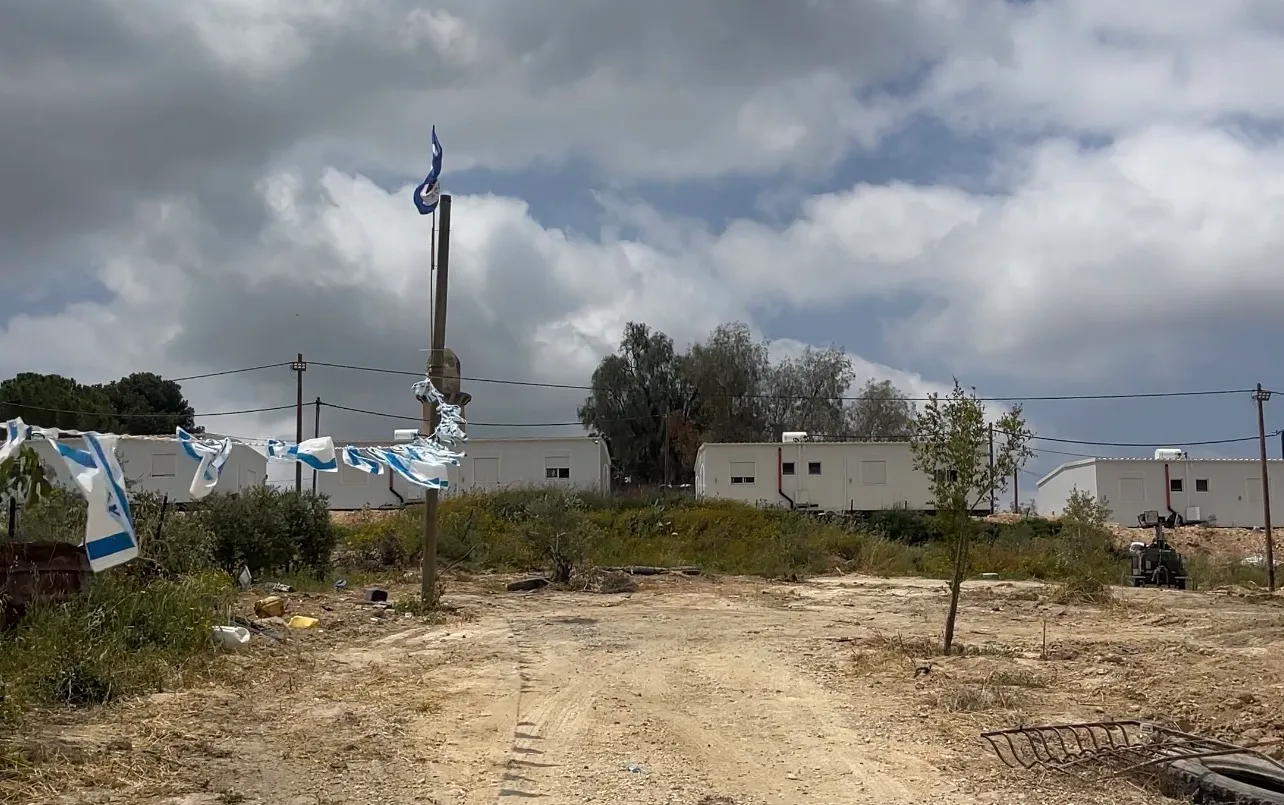
DEIR AMMAR, Occupied West Bank—Mustafa Badaha drove along the edge of his land, past rows of olive trees he could no longer access. A red string put up by Israeli settlers demarcated the border of what was stolen from him in Deir Ammar, a Palestinian town around 17 kilometers northwest of Ramallah in the occupied West Bank. The settlers had recently established a new outpost in the area named Ramataim Zofim.

“Everything is legal—I have permits—but it makes no difference. A settler comes and simply says, ‘This is my land. You have no place here,’” Badaha told Drop Site. For years, he cultivated the land, building a small summer home where his family would gather. “Now, no one can go there—if we try, we are attacked,” he said. “What was once my joy is now my greatest fear.”

A red string put up by Israeli settlers on Mustafa Badaha’s land in Deir Ammar in the occupied West Bank demarcating the land they took over. April 30, 2026. Photo by Naqaa Hamed.

Settlers began routinely attacking Palestinians in the area back in August 2025. “They came here armed, created problems with the youth and the families, and even fired live ammunition,” Badaha said. He contacted the Palestinian Authority, who reached out to Israeli authorities. “The attacks kept increasing day after day. At first, the settlers were about 500 meters away, then gradually they kept getting closer until they reached the houses,” he said. “Every day there are provocations. They block the road, and with the youth we reopened it several times. Recently, there was another major attack and they blocked the road again.” After contacting the Israeli police, the Israeli military eventually arrived and detained Palestinians from the community instead of the settlers.

“The youth were insulted, detained for over an hour, searched, and had their IDs checked. I asked the officer, ‘What are we supposed to do? You tell us not to react, but settlers are the ones attacking,’” Badaha exclaimed. “We are living under constant attacks. This is our home, our land—we have water, electricity, internet—everything. Yet there is no safety.”

Ramataim Zofim is one of 34 settlements secretly approved by the Israeli security cabinet in late March, a decision that was only revealed in Israeli news reports last month. It marked the largest number of settlements approved by any Israeli government at one time. The decision to officially approve new settlements or to legalize outposts allows for the establishment of water and electricity infrastructure, further entrenching their presence on Palestinian land.

The 34 new settlements established by the Israeli security cabinet join 68 settlements the current government has approved since its formation a little over three years ago. By comparison, only six new settlements were formally approved by Israel in the 30 years between the signing of the Oslo Accords in 1993 and the establishment of the current government. Over the past three decades, thousands of additional housing units have been approved within existing settlements, like Ma’ale Adumim which lies just east of Jerusalem and is home to up to 40,000 Israeli settlers.

“This represents an unprecedented pace and scale of expansion,” Amir Daoud, director of Publishing and Documentation at the Colonization and Wall Resistance Commission, told Drop Site. Until the establishment of the current Israeli government there were 127 official settlements in the West Bank, according to the Israeli group Peace Now. Adding over 100 new official settlements represents an increase of nearly 80%.

“These new sites are distributed across the West Bank in what can be described as a fragmented but comprehensive pattern, effectively targeting the entire territory,” Daoud said. “Overall, this wave of approvals reflects a clear race against time to impose as many facts on the ground as possible, in order to achieve long-standing strategic goals.”

A map of the 34 newly approved Israeli settlements approved in March 2026. Credit: Peace Now.

All 34 of the new settlements are located in Area C, a technical designation established under the Oslo Accords that divided the West Bank into three sections. Area A is technically under Palestinian civil administration and security control; Area B is under Palestinian civil administration but shares security control with Israel; and Area C is under full Israeli control.

The International Court of Justice, UN Security Council resolutions, and international law experts agree that all Israeli settlements in the occupied West Bank are illegal under international law.

“Consistent with long-standing settlement policy, these new sites contribute to the fragmentation of Palestinian areas while simultaneously creating territorial continuity between settlements,” Daoud said. “This is especially evident in central parts of the West Bank, where settlement placement further disrupts Palestinian geographic cohesion.”

Five of the newly approved settlements are in the governorate of Al-Khalil (Hebron) in the south of the territory and home to the largest Palestinian city in the West Bank. One of the settlements, which lies southwest of the city of Al-Khalil, named Meged, has affected land that Fahed Qawasmi and his family have cultivated for generations.

“My sister and I lost about three dunams [about 0.75 acres] of our land,” Qawasmi told Drop Site. “We only realized what was happening from neighbors—they had already taken around 300 to 400 dunams [about 74 to 100 acres] before reaching our land…We rushed there, but settlers attacked my brother on the land.”

The establishment of a new settlement has geographical ripple effects far beyond the actual settlement itself. “If a settlement is built, it won’t just take the land it stands on. It will expand around it, turning the surrounding areas into closed military zones,” Qawasmi said. “That means more land lost, more restrictions, and no access—not just for us, but for nearby homes and fields as well.”

Qawasmi said that grapevines more than 100 years old and police trees planted by his father were all uprooted. “This land is extremely valuable to us—not in money, but because it was passed down through generations. My father inherited it from his father, and so on. We were even offered to sell it before, but we always refused. This land is not for sale,” he said. “To lose it like this, without any right, is devastating. It destroys you emotionally.”

In the north of the West Bank, six of the newly approved settlements form a semi circle around Jenin, surrounding the Palestinian city from the west, south, and east.

“The land involved here is around 500 dunams [around 123 acres], and what’s happening now—through road construction and gradual takeover—means this entire area could effectively be confiscated,” Mohammad Arqawi, the head of the village council of Al-Arqah village in Jenin, told Drop Site. “And when 500 dunams are affected, it doesn’t just impact one group. It affects farmers, traders, workers, shepherds—the entire local community.”

A staggering 40,000 Palestinians have been displaced across the West Bank since the beginning of 2025 by demolitions, settler attacks, and access restrictions, according to a statement by the Deputy Spokesman for the UN Secretary-General Farhan Haq. Meanwhile, violence by Israeli settlers and soldiers against Palestinians in the West Bank and East Jerusalem has skyrocketed to unprecedented levels. According to the United Nations, between October 7, 2023 and April 23, 2026, at least 1,088 Palestinians—including 238 children— have been killed. Forty-two of them have been killed since the beginning of 2026. The UN said that the first four months of 2026 have seen the most violent start to a year since monitoring of settler violence and harassment began in 2013.

“This is just the beginning—the impact will grow,” Arqawi said. “Every time settlers attack, the army is present. The situation has become almost routine—settlers and army operating together on a daily basis.”

* Sharif Abdel Kouddous contributed to this report which is published in the Drop Site website

Continue reading