Gaza Beach Painting Relieves War Traumas

In a gesture of resilience and hope that rises above the aftermath of Israel’s two-year war on Gaza and the continued violations of the ceasefire agreement, Palestinian girls organized a seaside painting workshop in Gaza City.

The workshop, titled Breathe and Paint, was held on Thursday and underscored how the sea has become a place of refuge not only for artists, but for Palestinians seeking relief after enduring the genocidal war that began in October 2023.

Set against sunlight and gentle sea breezes, the initiative offered moments of calm and reflection, symbolizing life’s persistence despite attempts to extinguish it.

Anadolu attended the workshop, which took place at the fishing port west of Gaza City, away from areas devastated by Israeli attacks.

The event gave young Palestinian girls, many bearing deep psychological scars from the war, space to express emotions through art.

Using vivid colors, the participants momentarily set aside the trauma of war. Some painted Palestinian women in traditional dress, while others depicted the sea, the sun, and open horizons, reflecting hopes of renewal despite devastation.

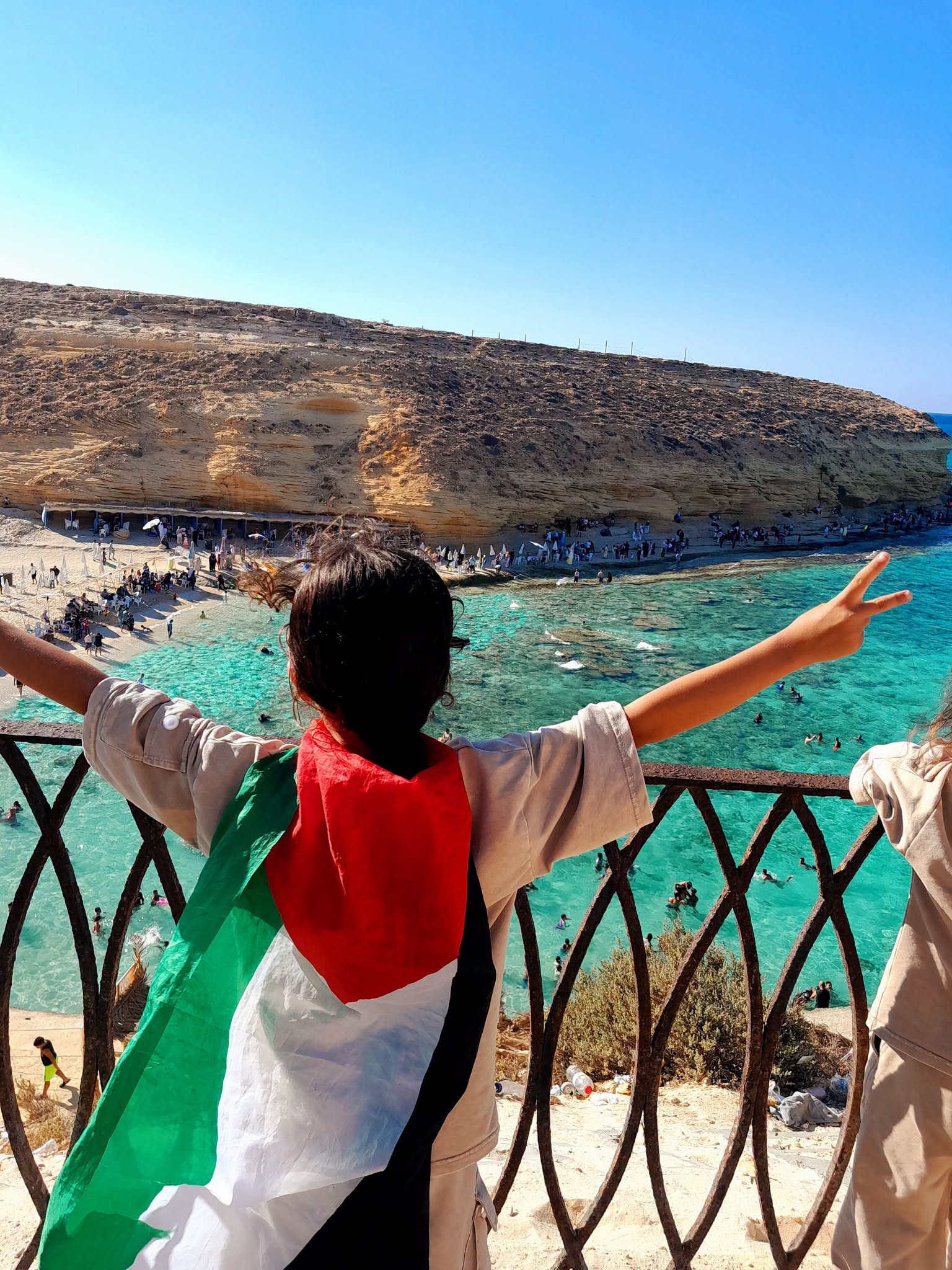
Drawings of the map of Palestine and the national flag also featured prominently, painted by young girls as expressions of belonging and attachment to their homeland.

Israel targets art

During the genocidal war, Israeli forces destroyed major cultural and artistic landmarks across Gaza — actions Palestinians say were aimed at erasing their cultural identity.

Among the destroyed sites was the Rashad Al-Shawa Cultural Center in Gaza City’s Rimal neighborhood, established in 1985.

Israeli attacks also killed dozens of Palestinian artists, including visual artist Heba Zaqout during the war’s first month, theater artist Durgham Qreiqa in March 2025, and standup comedian Mahmoud Shurrab, who was killed when his tent was struck in Khan Younis in June 2025.

Palestinian and international organizations, including UNESCO, repeatedly condemned the targeting of artists, but Tel Aviv has ignored these denunciations and continued its assaults.

A space to breathe

Participant Farah Ajjour said the sea offered rare emotional relief after two years of confinement under war.

“This workshop gave us a chance to release what we were holding inside,” she told Anadolu.

Amid gentle sea breezes brushing her weary face, she said life had been on pause and that she now longs to resume it.

She added: “After the cultural center in Gaza City was destroyed (by the Israeli army), we no longer had a place to practice art.”

Insisting on continuing with life, she said: “I want my voice to be heard through my art. There is no place where I can do that except the seashore; that’s why we are here today.”

Art as resistance

Workshop organizer Noura Al-Qassasiya said the initiative aimed to restore color to the lives of girls deprived of normalcy for more than two years.

“Art helps us communicate the harsh reality of the Israeli genocide,” she said, noting that reaching the location itself was difficult due to widespread destruction and displacement.

She explained that the sea was chosen because it remained untouched by bombardment.

“The people of Gaza love art,” she said. “We want to do that not only through bloody and heartbreaking images, as was the case over the past two years, but also through art.”

Participant Amal Darwish said painting finally allowed her to speak after years of silence.

“Through art, I found space to tell our story and express resistance,” she said, adding that her greatest wish was for life to return “in bright colors.”

Throughout the workshop, fear, loss, and grief were transformed into paintings, alongside visions of a life participants still hope to reclaim.

The Oct. 10, 2025 ceasefire agreement ended Israel’s two-year war that began on Oct. 8, 2023. Palestinian authorities say the conflict killed more than 72,000 Palestinians, wounded over 171,000 others, and caused widespread destruction affecting 90% of civilian infrastructure. The UN estimates reconstruction costs at approximately $70 billion.

At least 591 Palestinians have been killed and over 1,578 others injured in Israeli attacks since the ceasefire, according to Gaza’s Health Ministry.

Continue reading
Trump’s War Through Politics

By Dr Amani Al-Qarm

About 2,500 years ago, there was a Chinese general named Sun Tzu, renowned for his military genius and unique philosophy on achieving decisive victory. He compiled his vision in a famous book called “The Art of War.” Sun Tzu states in his book that subduing the enemy without fighting is better than winning a hundred battles, and that a skilled commander feeds on his enemies.

This means exploiting the enemy’s resources, weaknesses, and even strengths, striking at their strategy and alliances, and besieging them to achieve victory, rather than relying solely on one’s own resources. In other words, achieving victory at the lowest cost is preferable to destroying a country, and capturing the head of state is better than killing him.

The Trump administration’s slogan, “Peace Through Strength,” is not new to American administrations, but it was perhaps more blatant and explicit during Trump’s presidency, as was the case with everything else under his rule: no embellishment, no lofty phrases, no justifications to appease hypocritical Western arrogance, such as democracy and human rights. There are only declared and clear objectives: oil, minerals, money, and control without cost.

The entire world is watching the current unique American approach to dealing with the Islamic Republic of Iran. Just when the world expected an American strike on Iran, the door was opened for negotiations under the auspices of the massive aircraft carrier USS Lincoln and its destroyers and missiles stationed in the Arabian Sea.

This leaves allies and adversaries alike bewildered and unable to predict the outcome, while Trump maintains the element of surprise and the timing of the strike. It seems that Trump is not content with the slogan “Peace Through Strength” alone, but has added to it some of the principles of General Sun Tzu’s doctrine. Trump Feeds on His Enemies:

Iran is in a state of weakness unprecedented in decades. Internally, the country is seething with poverty and oppression, and the recent protests are unlike any before. Internal affairs are no longer purely domestic; they now carry external costs, given the threats the US president has made against the Iranian regime throughout the past month.

Furthermore, the country is strategically exposed. Its alliances have been shattered, and it and those who deal with it economically and militarily are besieged. The time is ripe to pounce on the prey. And because, as Tzu said, subduing the enemy without cost is better than winning a hundred battles, Trump has opened the door to negotiations to achieve his objectives.

What does Trump want from Iran? Is he negotiating to restore relations between the two countries? Or to liberate the Iranian people? Of course not. He seeks victory without a fight. The collapse of the country as a result of war would transform it into scattered chaos throughout the region, as has already been witnessed in Iraq, Libya, Yemen, and Syria.

Therefore, containing it to the greatest extent possible and completely changing its hostile behavior since 1979 is preferable to destroying it. And to strip it of everything it considers its sources of power: eradicating any nuclear ambitions, eliminating its missile program, and reducing its regional role to the bare minimum, while also constantly reminding it that America is serious and ready to confront it. From America’s perspective, qualitative and nuclear superiority should belong only to Israel in the region.

What happens next depends on Iranian behavior. Will it submit and be pragmatic, as it has been in the crises that have characterized its relationship with the United States since 1979, or will the Iranian regime feel that this crisis is existential, thus raising the voice of ideology where there is no turning back?

This article is republished from the Arabic Al Rai Al Youm website.

Continue reading
German Visit to Israel’s ‘Yellow Line’ Slammed

Bundestag President Julia Kloeckner’s visit to Gaza under Israeli military escort has drawn sharp criticism from lawmakers who called it a one-sided tour that excluded Palestinian perspectives.

The conservative politician traveled on Thursday with the Israeli army into what is known as the “Yellow Line” – an area occupied by Israeli forces for months that international observers fear could become permanent.

Adis Ahmetovic, foreign policy spokesman for the Social Democratic Party (SPD), criticized the visit in remarks to public broadcaster ARD, saying it sent the wrong message just days after Israel announced plans for de facto annexation of the occupied West Bank.

“This must not be legitimized,” the lawmaker said. “And such a visit to the Gaza Strip with the Israeli army does not help to clarify or criticize these plans, but may even give them further support.”

Ahmetovic noted that Kloeckner’s itinerary included no meetings with high-ranking Palestinian representatives. “No visit to the West Bank, no visit to East Jerusalem, and during her planned visit to Gaza, she didn’t listen to a single voice,” he said. “That’s something that’s difficult to explain.”

Franziska Brantner, co-leader of the oppostion Greens party, echoed the criticism in an interview with Der Spiegel magazine.

“It is good that Bundestag President Julia Kloeckner wants to see Gaza for herself,” she said.

“But if she does so without even listening to the Palestinian side, she must accept the criticism that she only wants to perceive reality in this region from one perspective,” she said.

Kloeckner’s Israel trip began on Tuesday. She visited the Yad Vashem Holocaust memorial on Wednesday, followed by a red carpet reception at the Knesset. She dismissed the criticisms, saying she raised the humanitarian situation in Gaza in meetings with Israeli officials and discussed the developments with opposition representatives and nongovernmental organizations. Anadolu

Continue reading
Gaza Readies For ‘Sweet’ Ramadan

As the Islamic holy month of Ramadan set to start next week, Palestinians in the Gaza Strip are preparing to mark the fasting month by reviving the tradition of making Qatayef on makeshift wood-fired stoves.

In Gaza, the arrival of the holy month is not counted in days, but sensed in the aroma of this classic Palestinian dessert once again filling the markets after two years of devastating war.

In the “Garage Rafah Market” in the city of Khan Younis in southern Gaza, which used to be crowded with shoppers before the Israeli war, a number of shop owners are trying to revive their businesses as the fasting month approaches. Among them are Qatayef makers who have returned to lighting wood stoves amid the rubble.

In the middle of widespread destruction and near areas still occupied by Israel east of the city, shop owners continue their work under difficult conditions, including shortages of fuel and gas.


Deep-rooted Ramadan tradition

With more than 20 years of experience, Salim Al-Bayouk — known as the “King of Qatayef” in the market — continues to prepare the dessert by hand despite scarce resources and the lack of basic materials.

Bayouk, 54, told Anadolu that he began the business in the city of Rafah before moving to Khan Younis after Israel occupied the city, expressing his determination to continue despite the difficult circumstances.

Qatayef is considered “the queen of Ramadan desserts” among Palestinians, distinguished by its ease of preparation and low cost. It consists of a small pancake filled with nuts, cheese, or dates, then baked and soaked in sugar syrup.

Bayouk said during Ramadan, his work primarily depends on cooking gas, requiring about 25 kg daily. However, supply shortages have forced him to rely on wood in order to continue his profession.

Since a ceasefire agreement came into effect in October, Israel has allowed limited quantities of cooking gas into Gaza, while the enclave needs 20 truckloads daily, according to local officials.

Despite shortages and rising operating costs, Palestinians insist on continuing, rejecting displacement and holding fast to Ramadan traditions they refuse to let disappear from their city.

Bayouk said he reduced the price per kilogram to 10 shekels (about $3) and provides work for 10 to 15 workers during the season, emphasizing his commitment to remain despite the damage to his shop and his reliance on makeshift repairs.

Hundreds of other Palestinians across different parts of the Gaza Strip also continue this seasonal profession among tents, narrow alleys, and crowded camps.

They set up makeshift stoves and light wood fires to compensate for gas shortages, attempting to revive a Ramadan ritual they are accustomed to despite the restrictions.


Basic dish

For his part, Saeed Khalaf, 38, said that the street where the market is located used to be packed with shoppers before the war, and it was nearly impossible to walk through due to the crowding.

“Qatayef remains a basic dish on every family’s Ramadan table,” Khalaf said, expressing hope for the restoration of normal life, and the actual implementation of the second phase of the ceasefire deal.

The ceasefire ended an Israeli offensive that began in October 2023 and lasted two years, killing over 72,000 Palestinians and wounding over 171,000 others, while destroying about 90% of Gaza’s infrastructure.

Despite the ceasefire deal, the Israeli army has continued to violate it, killing at least 591 Palestinians and injuring more than 1,578 others, according to Gaza’s Health Ministry

The US announced in mid-January the launch of the second phase of the agreement after delays, saying the plan includes further Israeli troop withdrawals, transitional governance arrangements for Gaza, and the start of reconstruction efforts.

By Serdar Dincel for Anadolu

Continue reading