Netanyahu Has Irked Trump. Why?

What should one make of the recent White House meeting between US President Donald Trump and Israeli Prime Minister Benjamin Netanyahu?

Well, this time Netanyahu was almost summoned to the White House to be told few home truths. This meeting was not like the first time when Netanyahu came to the White House in early February when it was all glow to be unexpectedly told that Trump wants the USA to take over Gaza.

This time around, the meeting was more subdued, almost in a rush, like an after-thought on the part of Trump who keeps chopping and changing as he figures out how he wants to conduct America’s foreign policy in his second “robust” administration.

This time around, although Trump displayed the usual friendliness to Netanyahu, he was somewhat distant because of the tariffs the White House is set upon to start imposing on the rest of the world including best-friend Israel. Its leaders, businessmen are still in shock because Washington has slammed a 17 percent tariff on its products entering the United States.

Israeli industrialists continue to be up-in-arms. It was they who appealed to Netanyahu to seek Washington clarification because they argued that the new tariffs will cost them up to $3 billion in losses, reduce Israeli exports by 26 percent and increase unemployment by 26,000. They are already in a bad situation because of the war on Gaza but this latest step will surely cripple them.

At the White House meeting last Monday, with a chitchat in front of the cameras that looked as if it was a rehearsed meeting with Trump dominating the conversation and everyone taking their que to speak only when they are told, he pointed out to Netanyahu that he “may not” consider reversing tariffs on Israeli exports because “we give Israel $4 billion a year. That’s a lot.” He really sounded like lecturing to the Israelis.  

For a man considered to be greatly influenced by the Israeli lobby that seemed to be tough talking for in the immediate conversation Trump told Netanyahu that there would be and for the first time direct face-to-face talking with Iranians about their nuclear file.  

This seemed to be another unsuspecting blow. If there was a “shock” on his face, Netanyahu didn’t show it as he just nodded; the Israeli Prime Minister was looking for a tough military stance on Iran, possibly going to war and striking the country’s nuclear facilities. It was he, who persuaded Trump in 2018 to exit from the 2015 nuclear deal brokered by the UN with other world powers of Britain, France, Russia, China and Germany at the behest of the Barack Obama administration.

Now with Trump in the driving seat, and wanting a “tainted-Donald” deal, Netanyahu couldn’t but agree with an alluring American president. If he had any misgivings, he kept them to himself except to say Tel Aviv and Washington had an objective not to let Iran have nuclear weapons, but Tehran constantly said and throughout the past years that their nuclear program was for peaceful purposes unlike the clandestine extensive Israeli nuclear program.

Although he may not have outwardly shown it, Trump may have been a little irritated by Netanyahu in other ways. Take Gaza for example when Israel restarted its war on the enclave on 19 March exactly two months after a ceasefire took effect ending a 15-month genocide and which was brokered by Trump and his team lead Steve Witkoff.

The recent talks in the White House, and shown in front of the cameras suggest Trump would have like more time for the Doha negotiations to take hold between Hamas and Israel to see the release of the 59 remaining hostages – which include one American who is still deemed to be alive – hidden in the Gaza enclave.

The relaunching of the war, and so quickly, and with the breaking of the 19 January ceasefire is adding to the tension between Washington and Tel Aviv and is sending signals that Netanyahu wants to continue the war in Gaza and doesn’t particularly care about the remaining hostages, and whether they come out of their nightmare dead or alive.

Trump, and as shown by the White House meeting, is showing a diversion from thoughts projected by Netanyahu. As well as Iran, he has told Netanyahu, he favors Turkish President Recep Tayyip Erdogan and that he has a ‘very, very good relationship with Turkey and with their leader…”, adding that “I happen to like him, and we never had a problem” and he offered to mediate between Israel on any problem between the two countries.

Such words may have suddenly added to the glum mood of the Israeli PM who fears that Turkish influence in Syria despite the fact it is Israel that is today bombarding different Syrian cities and occupying parts of their territory, a situation that increased after the toppling of the Bashar Al Assad regime on 9 December, 2024 by a new government in Damascus, and which is seen as a threat to Israeli security by Tel Aviv.

What is worrying Netanyahu is the fact Trump recognizes Turkish influence and Syria and Ankara’s relationship with the new government in Damascus, and apparenty the man in the White House, is “ok” with it.

With all this going on, Netanyahu is not sure anymore of the way the White House is going despite the fact that Washington continues to be the main supplier of weapons to Tel Aviv. But with Trump as “fickle-minded” as he is, all cards are on the table for a new and changing relationship between the USA and the rest of the world with the strong possibility of including Israel in the new international set of thinking.

This comment is written by Dr Marwan Asmar, chief editor of the crossfirearabia.com website. 

Continue reading
Guterres: ‘…Time to End the Gaza Dehumanization’

With no aid allowed into Gaza for more than a month, the UN Secretary-General appealed on Tuesday for guaranteed humanitarian access to the enclave. 

Speaking to journalists at UN Headquarters, António Guterres also repeated his call for a renewed ceasefire between Israel and Hamas, and the release of all hostages still being held inside the shattered enclave.

No food, fuel, medicine and commercial items have entered Gaza since 2 March following the Israeli blockade, and supplies are piling up at crossing points.

Meanwhile, the ceasefire announced in January following 15 months of war has collapsed, amid airstrikes, renewed ground operations and rocket launches into Israel by Palestinian militants. 

‘An endless death loop’

“As aid has dried up, the floodgates of horror have re-opened,” Mr. Guterres said.

Gaza is a killing field – and civilians are in an endless death loop.”

He noted that “certain truths are clear since the atrocious October 7 attacks by Hamas,” chiefly that ceasefires work.

The truce allowed for the release of hostages, as well as the distribution of lifesaving aid, and proved that the humanitarian community can deliver.

Shattered hope

He recalled that “for weeks, guns fell silent, obstacles were removed, looting ended – and we were able to deliver lifesaving supplies to virtually every part of the Gaza Strip,” which ended with the “shattering” of the deal.  

Hope sank for Palestinian families in Gaza and families of hostages in Israel – as I was reminded when I met again with hostage families yesterday,” he added.

For this reason, the Secretary-General has consistently been pushing for the immediate and unconditional release of all hostages, a permanent ceasefire, and full humanitarian access to the territory.

“In times like this, we must be crystal clear,” he said, noting that with crossing points shut and aid blockaded, there is no effective security and the ability to deliver assistance has been strangled.

He also cited a joint statement by UN humanitarian chiefs, issued on Monday, which refuted assertions that there is enough food in Gaza to feed everyone there.  

International obligations 

“We must also be clear about the obligations,” Mr. Guterres continued, emphasizing the “unequivocal obligations” of Israel, as the occupying power, in line with international law.

He pointed to the Fourth Geneva Convention, which outlines the duty to ensure food and medical supplies for the population, as well as ensuring and maintaining medical and hospital establishments and services, public health and hygiene.

Additionally, medical personnel shall be allowed to carry out their duties.

“And Article 59, paragraph 1, of the Fourth Geneva Convention provides that ‘if the whole or part of the population of an occupied territory is inadequately supplied, the Occupying Power shall agree to relief schemes on behalf of the said population, and shall facilitate them by all means at its disposal,’” he quoted.

International humanitarian law also includes the obligation to respect humanitarian relief personnel, he added, paying tribute to the “humanitarian heroes” under fire in Gaza. 

Against new ‘authorization mechanisms’ 

While UN agencies and partners stand ready and determined to deliver, “the Israeli authorities newly proposed ‘authorization mechanisms’ for aid delivery risk further controlling and callously limiting aid down to the last calorie and grain of flour,” the Secretary-General said. 

“Let me be clear: We will not participate in any arrangement that does not fully respect the humanitarian principles: humanity, impartiality, independence and neutrality.”  

Mr. Guterres said unimpeded humanitarian access must be guaranteed, and humanitarian personnel must be given protection, in line with international law.  

He stressed that “the inviolability of United Nations premises and assets must be respected,” and again called for an independent investigation into the killing of humanitarians, including UN personnel.

Dead end ahead 

The Secretary-General concluded the briefing by underlining the need to stick to core principles. He urged UN Member States to adhere to their obligations, adding that there must be justice and accountability when they do not

The world may be running out of words to describe the situation in Gaza, but we will never run away from the truth,” he said. 

He warned that “the current path is a dead end – totally intolerable in the eyes of international law and history,” while the risk of the occupied West Bank transforming into another Gaza makes the situation even worse.

“It is time to end the dehumanization, protect civilians, release the hostages, ensure lifesaving aid, and renew the ceasefire,” he said.

UN News

Continue reading
10 British Citizens Face Gaza War Crimes – Guardian Newspaper

The Guardian newspaper revealed, Monday, that 10 British citizens who served in the Israeli occupation army face charges of committing war crimes in the Gaza Strip, based on an extensive human rights report prepared for submission to the British Metropolitan Police.

The 240-page report is based on investigations conducted by human rights lawyers, in collaboration with the Palestinian Centre for Human Rights in Gaza and the London-based Public Interest Law Centre. The report covers serious violations committed between October 2023 and May 2024.

According to the document, the accused soldiers—including Israeli army officers—are suspected of involvement in launching indiscriminate attacks on civilian areas in the Gaza Strip, including hospitals, in addition to causing mass displacement and targeting sites protected under international law.

The report also accuses these individuals of deliberately targeting civilians and aid workers, which may amount to crimes against humanity.

Although the full report includes the names of the accused soldiers, it will not be made public for legal reasons. It was prepared by a team of British lawyers in collaboration with researchers in The Hague according to Qudspress.

Continue reading
Can Arab States Stop The Israeli Genocide?

Neither the Israeli war nor the ethnic cleansing of Gaza will ever stop if there is no forceful, determined intervention from the outside. 

And primarily this intervention has to come from the Arab countries and the pan-Arab nation as a whole: If these states – so-called Arab brethren and Islamic affiliates bound by common language and culture – don’t stand up and say ‘no’ to Netanyahu’s bloody war on Gaza, now in its 15th month, the ethnic cleansing, devastation, destruction and possibly the near and future displacement of the Palestinian people will continue to be hummed.

No bland utterances

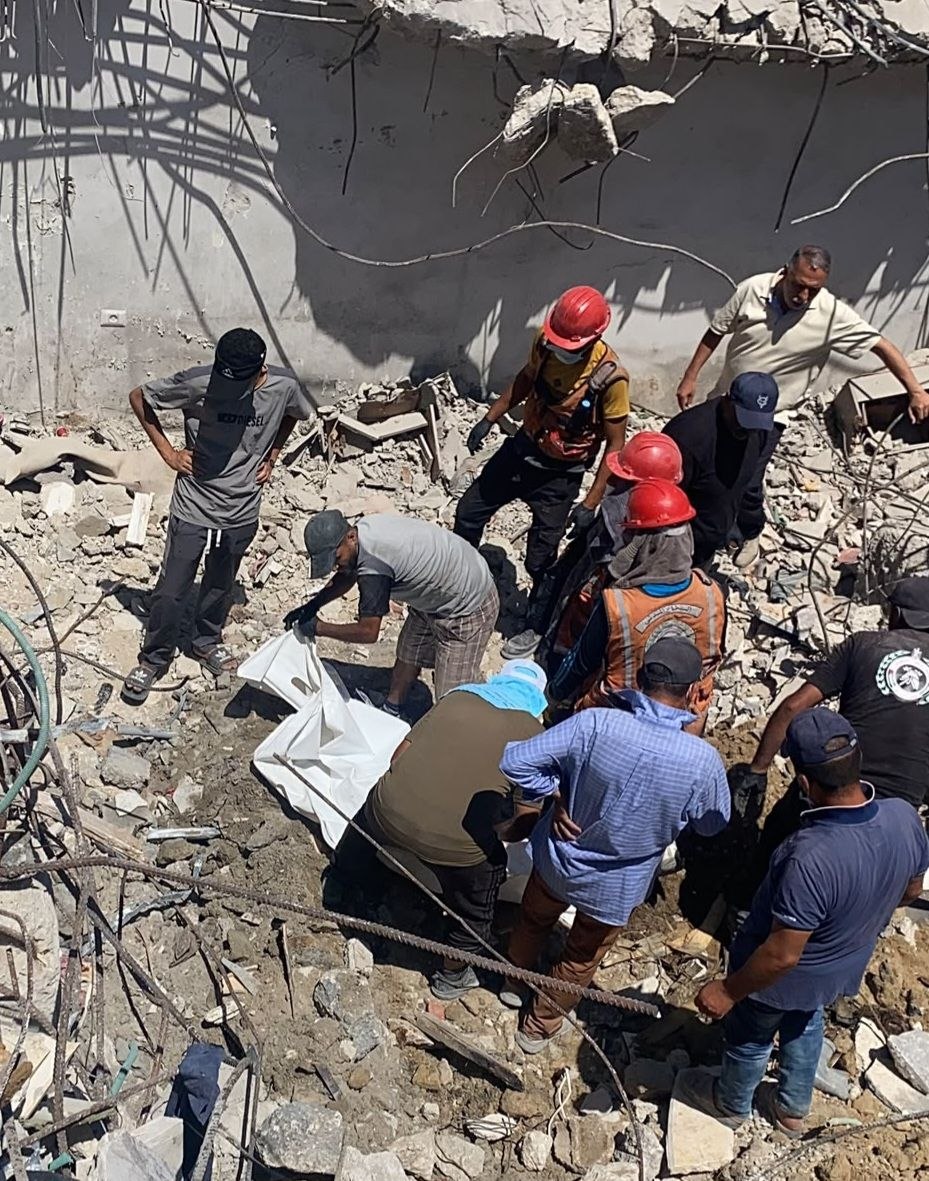
Arab countries, from the far-west to the center and all the way to the east must move beyond bland utterances and condemnations of the mindless bloody Israeli military actions on Gaza that has so far resulted in the killing of more than 50,000 people, internally displaced more than 2 million of the population with 14,000 dead yet to be recovered from under the millions-of-tons of rubble that needs years to clear out.

As well, and further stated by Palestinian activist Dr Mustafa Al Barghouti, Arab states have to now develop at least a two-pronged strategy to drive the message across that they will not stand ideally by and watch the Palestinian people of Gaza being massacred and driven to smithereens.

Arab countries, and incidentally this should have been done a long time ago, which have normalized with Israel must freeze their diplomatic relations with the Zionist entity. Their leaders must say to Prime Minister Benjamin Netanyahu that relations will remain cut and frozen and that no further relations will take place, until he ends the Israeli war on Gaza and from now on, its back to the “bad old days” of a black Cold War between the Arab countries and Israel. 

The message needs to be loud and made crystal clear by Arab leaders for Netanyahu and his extremist government and military men to stop the carnage, killing and mayhem that is being created in Gaza and its people.

Determined Arabs

It is only through such a determined approach that will force the Israeli government, its leaders and ministers to sit, think and possibly review their slaughter of the Gaza enclave. At the very least, they would be forced to put the “brakes on” to their “happy attitude” of committing their atrocious massacres carried out almost daily since 7 October, 2023.

What is needed is a credible deterrence with those in power moving beyond their pedestals and high chairs and plush stages and put words and action together for the Arab world is nowhere as helpless on this issue as it is being projected.

All of the 22 Arab countries have now a real opportunity to stop the Gaza massacres through the new American president at the White House Donald Trump. He forced Netanyahu’s hand for a temporary ceasefire starting 19th January, 2025 which continued for almost two months and he can do it again if he wanted to and/or forced to. At the moment there is no political will.

Effective tool

Despite the present-relaunching of the war on 19 March, basically through an American green-light, Arab countries can have an effective and meaningful role if they choose to. After all, Trump soon backed down when he first suggested that the USA take over Gaza and turn it a Middle East Riviera whilst displacing its people to neighboring countries such as Jordan and Egypt.

He soon retreated from pursuing such an idea especially when Arab capitals such as Cairo, Amman, Riyadh, Algiers, Beirut, Kuwait, Doha, Muscat and Abu Dhabi condemned such a move with Netanyahu even having the audacity to say  Palestinians can have their state in Saudi Arabia. Trump’s Riviera idea soon became bogged down but Israel shortly after, restarted its war on Gaza, again with the blessing of the US administration.

But here again, and today the Arab countries, can make their move. The USA has vital, strategic, economic and political interests in the world and these can be used in different ways to persuade Washington to pressure Tel Aviv to back down on Gaza, other than promising to continue its bloody onslaught on ordinary Palestinians in Gaza with the hope of getting rid of Hamas and which according to their calculations they can’t beat until 2027 and/or whenever.

Netanyahu must be made to stop! He is not doing so because of the ongoing military supplies and backing from the United States and from the muted Arab response which have to go beyond condemnation and denunciations. Arab states have the tools at their disposal, it is time for these to be uses effectively otherwise the Israeli genocide will continue and expand.

This comment is written by Dr Marwan Asmar, chief editor of the crossfirearabia.com website.

Continue reading
‘In Gaza We Die a 1000 Deaths a Day’

For over a year and five months, the people of Gaza have endured an unrelenting war of extermination—one that has robbed them not only of life’s comforts but of its very essence. Eighteen months of ceaseless suffering, where mere survival has become an act of defiance. The Israeli genocide in Gaza has drained every ounce of their strength—physically, mentally, and emotionally. And for those not granted the mercy of a single, swift death, every moment is a slow, agonizing descent into an unspeakable catastrophe. A never-ending cycle of death inflicted upon them by Israel—where one does not simply perish once, but dies a thousand deaths every day.

Under the relentless barrage of missiles raining down upon us, every passing moment is a gamble with fate. If we escape death today, there is no certainty that it will not claim us tomorrow—for in Israel’s eyes, we are all targets. As if the ceaseless bombardment were not enough, we are also stripped of life’s most basic essentials: food, water, electricity. Existence itself has been reduced to an endless procession of lines—one for a sip of clean water, another for a brief charge of a phone, yet another for a meager ration of humanitarian aid.

But among all these hardships, one of the most crushing has been the loss of cooking gas. With the suffocating blockade and the total closure of border crossings, the last fragile thread connecting us to a semblance of normalcy has been severed. Preparing a meal has become an ordeal, an insurmountable task that drapes every household in Gaza with the weight of exhaustion and despair.

The Cooking Gas Crisis: How It Began

Even before the total closure of Gaza’s crossings during Israel’s war of extermination, access to cooking gas was already scarce, failing to meet the population’s basic needs. Nowhere was this crisis felt more acutely than in the north, where gas barely trickled in—even during the rare moments when Israel allowed limited supplies into the south.

When a brief ceasefire was brokered—only to be swiftly shattered by Israel—residents of northern Gaza were once again left without their share. And the moment the ceasefire ended, the crossings were slammed shut once more, plunging people back into uncertainty, forcing them to navigate survival in the face of the unknown.

Malak Radwan, a resident of northern Gaza, recalls: “The first time we managed to get any cooking gas was after the ceasefire in February, 2025. But it didn’t come from our area—we had to depend on our relatives in the south to share what little they had.”

In southern Gaza, gas distribution operated through a system known as “Gas Lists,” where families were registered in a turn-based queue to receive their cylinders. Even then, the allocated amounts were woefully insufficient to meet the needs of the population. Yet, despite its scarcity and inflated cost, gas was still seen as a rare privilege—one that people clung to with gratitude.

But as the siege tightened and Israel’s total closure of the crossings dragged on, these lists became little more than illusions of hope—long, stagnant lines that might never move. According to the Government Media Office in Gaza, the Israeli occupation has prevented the entry of 18,600 aid trucks and 1,550 fuel trucks, including those carrying cooking gas, further exacerbating the suffering of the Palestinian people. Left stranded in uncertainty, families were forced to seek out alternative ways to cook, even as every other resource around them faded into oblivion.

Alternative Cooking Methods Amidst Catastrophe

They say necessity is the mother of invention, but what happens when all means of invention have vanished? Can the resort to primitive methods still be considered innovation in the face of such overwhelming disaster?

In Gaza, residents have been driven to rely on primitive cooking methods—each effort a dangerous gamble that weighs heavily on their bodies, their souls, and their fragile mental state.

Once, gathering around a coal fire to brew tea on a cold winter’s night was a beloved family ritual, a moment unmatched in its warmth. But now, that same fire has been forced upon us as a way of life—one that ignites not only our stoves but also the anguish in our hearts.

Yet, even firewood has become a distant luxury. Its price has soared, driven by the scarcity of trees, forcing some to scavenge shattered wood from the ruins of bombed homes or burn whatever fragments of furniture they have left. Never did we envision a day when we would be compelled to set our own belongings aflame just to prepare a meal.


“My fingers seem to melt with the fire every time I light it,” my mother sighs.

With firewood becoming prohibitively expensive, many have resorted to standing in yet another queue—this time in front of makeshift clay ovens, hoping to cook whatever food they have left. Umm Mohammad, a displaced woman from northern Gaza, has started her own small business: operating a clay oven where she bakes bread and prepares meals in exchange for a few Shekels.
“I began this work to support myself after losing everything during my displacement to the south. At the same time, I wanted to help those who have no means of cooking in their homes or tents,” she says.

For many families, even a few shekels are out of reach. The only remaining option is to rely on community kitchens—yet another queue to stand in, another obstacle in the endless struggle for survival. These kitchens provide just one meal a day, forcing many to subsist on cold canned food for the rest of their meals. Even the single meal was denied to them by the Israeli occupation. According to a report issued by the Government Media Office in Gaza, the Israeli occupation has directly targeted 60 charity kitchens and aid centers in a ruthless campaign aimed at starving the Palestinian people in Gaza. This has resulted in 80% of Gazan citizens losing their source of food.

The impact has been especially harsh on children and the elderly, who desperately need warm, nutritious food to sustain them.

And this is yet another burden we set aside amid the bleakness of our lives. Here in Gaza, the closure of border crossings is not the only barrier worsening the disaster of cooking gas shortages. As Gazans, we do not have the luxury of choosing our daily meals, nor do we have the privilege of enjoying a well-balanced diet. Every day, we are forced to go to the market, only to face the recurring frustration of missing food supplies. We are compelled to prepare meals we do not desire because no alternatives exist, and to eat unbalanced meals because we cannot afford anything better. Here, every moment we endure is a catastrophe in itself.

The Health and Social Consequences of the Gas Shortage

The crisis extends far beyond the inability to cook—it has dire implications for both health and society. Malnutrition has become rampant due to the lack of proper food preparation, leading to widespread cases of general weakness and anemia, especially among children.

Respiratory illnesses have also surged, as people are forced to burn wood and coal inside their homes, inhaling thick smoke with every breath. This has exacerbated the suffering of the sick and elderly.

Amani Al-Ghefari, a resident of northern Gaza, recounts her ordeal: “As someone with nearsightedness who wears corrective glasses, the smoke from burning wood has not only worsened my vision but has also caused a constant burning in my eyes, accompanied by migraines and relentless coughing. The most harrowing consequence, however, has been the physical strain—splitting firewood has taken a severe toll on my joints, leading to months of painful physical therapy.”

But the catastrophe is not limited to physical health—it has deeply scarred the psyche of every Gazan. Food is no longer just a means of sustenance; it has become a haunting memory of life before the genocide. The warmth of family gatherings around a meal has been replaced by a daily struggle for mere survival.
One mother confesses in anguish:
“I can no longer cook a warm meal for my children. I feel helpless, unable to provide for their most basic needs.”

Gaza’s Plea for Its Most Basic Rights

Amidst this suffering, numerous humanitarian organizations have made urgent appeals for aid to enter Gaza. The World Food Programme has expressed concern over the closure of 25 bakeries it supports in Gaza, due to a lack of fuel and flour. Yet, Israel continues its punitive policies, blocking fuel and essential supplies. Human rights advocates persist in calling for the immediate reopening of crossings and the unrestricted flow of aid to all areas of the Strip.

What is happening in Gaza is not merely a humanitarian crisis—it is an orchestrated catastrophe. Life as we knew it has been obliterated, and the suffering has surpassed all conceivable limits. Now more than ever, there is an urgent need for decisive international intervention to save the people of Gaza and to lift the inhumane siege that deprives them of even the most basic right—to cook their own food.

Silence is no longer an option. Every passing moment means more hunger, more pain, more devastation. Supporting Gaza is not just a humanitarian duty—it is a moral imperative that the world can no longer afford to ignore.

Quds News Network

Continue reading