Iran’s Army Calls on Israelis to Leave

Iran’s armed forces called on Sunday Israelis to leave their country, warning it may not be “inhabitable” in the days to come, state news agency IRNA reported, as military confrontation between the two regional rivals continues.

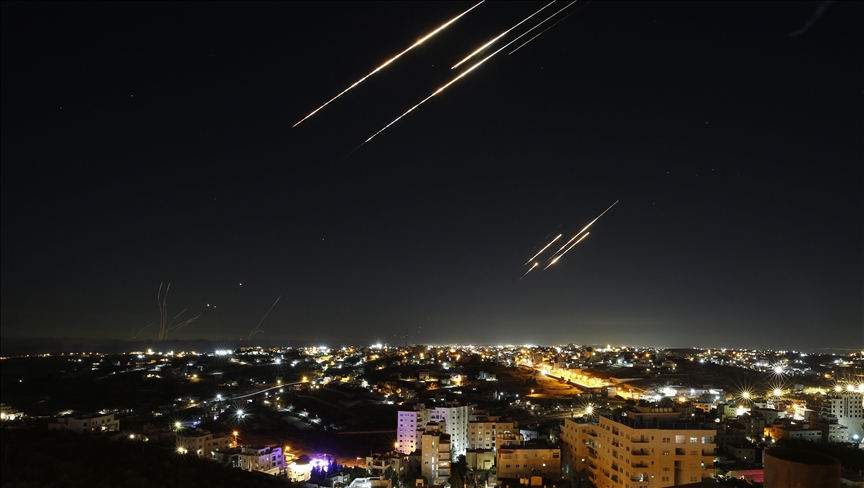
“Warnings for you in the coming days: Leave the occupied territories, because, certainly, they won’t be inhabitable in the future!” Reza Sayyad, spokesperson for the armed forces, said after a new wave of Iranian strikes began against Israel.

He cautioned that “taking shelter underground will not bring safety to the Israelis.”

“Therefore, we would like to emphasize: do not let the criminal regime use you as human shields,” Sayyad said.

Separately, Mohsen Rezaei, a senior IRGC commander who is also a member of Iran’s Expediency Council, said: “We may reach a point where we take major actions that will destabilize the entire region.”

Rezaei said “the wise people in the US and Europe must act quickly to pull their countries out of this war, otherwise we cannot stand by and watch their involvement without responding,” according to Anadolu.

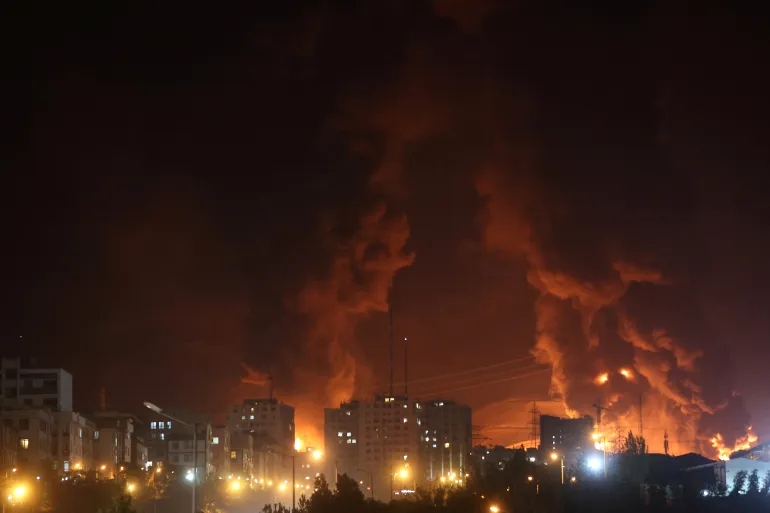
Israel launched airstrikes on multiple sites across Iran, including military and nuclear facilities, on Friday, prompting Tehran to launch retaliatory strikes. The attacks and counterattacks have continued since.

US President Donald Trump said the two sides could achieve peace and that meetings and calls to this end were taking place.

Continue reading
Why Doesn’t Trump Want Netanyahu to Strike Iran?

By Dr Marwan Asmar

CROSSFIREARABIA – United States president Donald Trump seems to be a very happy man these days. He says he is about to reach a deal with Iran on its nuclear file very soon.

Israeli Prime Minister Benjamin Netanyahu on the other hand is particularly worried, concerned, frustrated and even downhearted. He says ‘we need to strike Iran now before it’s too late and it goes ahead and develops a nuclear bomb’. 

But, and on the contrary, Trump believes that it’s because Iran is still at a weak stage before reaching nuclear  weapons capability, the US can force a deal that would make sure it checks its nuclear arsenal and would submit to the American will.

To prove his point, Trump through his US negotiating team led by Steve Witkoff, is continually talking to the Iranian team through Oman, now in their fifth mediating session about ironing out a new deal that would satisfy the US point of view and give the Iranians peace of mind and something to look forward to like lifting sanctions on the country.

To that extent, and no doubt for public relations, Trump is never short these days on complementing the Iranians with his glowing uttrances on the country and how it can become “great” again.

By their own accord however, both teams who are talking indirectly through the Omanis, say that negotiations is tough and may even going through a rough patch.

The Iranian delegates are sticking to their position, they want a deal but not at any price. They want to continue to pursue their uranium enrichment program believing this is a question of state and national sovereignty. They say they haven’t reached such a local, indegenous breakthrough in order to give it, whilst praising their scentific and technological advancements in this area of power.

The Americans on the other hand insist that Iranian divest itself from this nuclear process for uranium enrichment is a ‘redline’ as it leads to the possession of a nuclear weapon. To the Trump administration, this point is intractable which Iran has to give up on. 

But if this is the case why is the US continuing to talk to Iran? Further still, why should Trump be happy and talk about an impending deal that would lock the hands of the Iranians? Clearly, the American president is happy despite the murky regional waters.

Back to Israel. Netanyahu is deeply worried and wants to frustrate any impending nuclear deal. But he was always frustrated about Iran and argued, well, at least for the last 10 years, against talking to Iran and placating it. It was argued he was the person to convince Trump to leave the international JCPA treaty signed between the five-members of the UN Security Council and Iran in 2018.

Today however, and for Netanyahu, its “horrors” on the horizons. Leaked newspaper reports in The New York Times suggest there is deep tension between Trump and Netanyahu on this issue for the US president doesn’t want the later to embark on any action such as military strikes that would jeopardize any upcoming deal.

That is why Israeli Strategic Affairs Minister Ron Dermer and Mossad Chief David Barnea are being invited to Washington to the White House to impress upon them not to embark on a drastic Israeli action and bomb Iranian military and nuclear sites whilst negotiations are going on.

Many US and European experts however are fearful that Netanyahu wouldn’t be able to be controlled and if he embarks on striking Iran he would do so without consulting the Americans and go it alone and in spite of the ‘talked-about” pressure that is being exercised by the White House on Tel Aviv.

Regardless however, Trump wants a deal come what may for he believes this would be a great achievement for America and would vindicate his earlier action when he got the US out of the deal in 2018 and now in return for a better accord, and moving his own view to create a safer world and enforce his image that he is a man of peace and doesn’t support world wars like his recent attempt to stop the Ukraine War.

If Israel does strike Iran, in theory that would make Trump very unhappy because it would mean the United States is no longer able to control its strategic ally, or it could mean that behind the international and regional diplomatic chit-chat, the US is not too bothered about striking Iran.

But there are also other problems to consider: Wouldn’t a strike on Iran, especially on its nuclear sites, produce a spiral and a slippery-slope in which the latter would surely retaliate and be capable of doing so, with vehement force.

Apart from what that would do to the region, ie, “nuclear catastrophe”, would Netanyahu go along that road and risk annihilation for Israel and its surrounding areas.

These are tough questions to consider and may force Netanyahu to back down and listen to the US.

Continue reading
Can ‘Realist’ Trump Pull Off Gaza Ceasefire?

By Michael Jansen

During his ongoing visits to Saudi Arabia, Qatar and the Emirates, US President Donald Trump seeks to focus on business opportunities and investment in the US rather than address the negative political realities to which he contributed during his first term (2017-2021).

At that time, he dismissed the two-state solution in favour of “The Deal of the Century” which would give Palestinians a degree of autonomy within Israel. He defunded UNRWA, recognised Jerusalem as Israel’s capital, moved the US embassy there, and said the US no longer considers Israeli settlements illegal overturning a 1978 policy. The fate of the refugees, Jerusalem, and settlers were meant to be negotiated under the two-state solution by the sides under the 1993 Oslo accord. He closed the US consulate in occupied East Jerusalem which served Palestinians and the PLO office in Washington. Trump recognized Israeli annexation of Syria’s occupied Golan.

Trump began his second term by calling for the expulsion of Palestinians from Gaza which would be redeveloped as a Middle East Riviera instead of exerting pressure on Israel to end the Gaza war and enable its reconstruction. Under Trump’s real estate venture Gazan Palestinians were supposed to settle in Egypt and Jordan, which along with all the Arabs flatly rejected this proposal. Egypt drew up a counterproposal to reconstruct devastated Gaza while its population stays put.

His resort scheme has angered the Arab public from the Gulf to the Atlantic. His call for Saudi Arabia to establish relations with Israel has been rejected as Riyadh has said it will normalise when there is a Palestinian state with its capital in Jerusalem.

Since Trump made Saudi Arabia his first foreign destination in 2017 during his first term, the region has changed significantly by pivoting to the East. Saudi Arabia and the Emirates have cultivated ties with Russia – Riyadh’s partner on oil production and pricing – and China which buys Gulf oil and exports billions of dollars in goods to the Gulf. The Emirates, Egypt and Iran joined BRICS (the grouping of Brazil, Russia, India, China, and South Africa) while Saudi Arabia applied but did not follow through. China mediated Saudi-Iranian reconciliation. This has ended Iran’s isolation in the region.

On the positive side, early in this term Trump opened talks with Iran over its nuclear programme to replace the 2015 deal from which he withdrew in 2018. A fifth round of talks is expected. Although Trump wants to be a peacemaker, he has threatened war if the talks fail.

As a peacemaker, Trump bombed Yemen heavily to force Yemen’s Houthis to end attacks on international commercial and naval vessels in the Gulf of Aden and the Red Sea. The Houthis and US agreed to end this confrontation. Trump has not, however, halted Houthi drone and ballistic missile attacks on Israel which the Houthis say will stop if Israel observes a ceasefire or ends the war on Gaza.

Trump has not planned to stop in Israel during this Gulf tour, indicating that there is some distance between him and Israeli Prime Minister Binyamin Netanyahu. He has not only refused to ceasefire in Gaza but also maintained a ten-week blockade of the strip. He could have done both to ease Trump’s swing around the Gulf where Gaza is high on the agendas of the rulers and public. Since Netanyahu has carried on with his Gaza war, Trump has ignored him when resuming talks with Iran on limiting its nuclear programme in exchange for lifting sanctions and agreeing to a ceasefire with Yemen’s Houthi. The ceasefire has been welcomed by Washington’s Arab allies, particularly Saudi Arabia which had been urging an end to US attacks on Yemen before Trump began his tour.

Without Israeli involvement, the US has also negotiated with Hamas over the release on Monday of US-Israeli hostage Edan Alexander. For Trump, this is a greatly desired success in the US. In Israel, families of hostages who are not US-Israel dual citizens fear their relatives will be forgotten by Netanyahu who is determined to not only continue with the war but also to expand it once Trump departs from the region. Hostage families are not alone in their suspicions. A majority (54 per cent) of Israelis said that the war was being driven by personal rather than security reasons. Only 21 per cent agreed with Netanyahu’s prioritisation of eliminating Hamas over rescuing the hostages. A March poll showed 70 per cent of Israelis wanted Netanyahu to resign.

He has adopted this stance for several reasons. First, right-wingers in his coalition have vowed to pull out if he ends the war. Second, once the war is over, Netanyahu will be called upon to account for lax Israeli security in the south where Hamas breached the fence on October 7th, 2023, killed 1,200 Israelis and visitors and abducted another 251. There was no excuse for laxity. Young female Israeli soldiers deployed as “watchers” along that part of the border with Gaza, warned repeatedly that Hamas was conducting drills and manoeuvres ahead of an attack. Their warnings were not taken serioiusly by senior Israeli officers. Some of these women were killed and some captured. Third, as long as the war is being waged, Netanyahu will not have to explain how lightly armed Hamas fighters have managed to carry on the fight while the mighty Israeli army and air force levelled Gaza and killed 53,000 Palestinians. Netanyahu has a lot of explaining to do.

Jansen is a columnist for the Jordan Times

Continue reading
Trump’s Twist With The Houthis

By Dr Khairi Janbek

During his meeting with the Canadian Prime Minister Mark Carney, US President Trump interrupted the proceedings and declared that the American bombing campaign against the Houthis has stopped. He said, they don’t want to fight us so we respect that.

Now, what does that translate to, is not really very clear. Does it mean that the Houthis will not attack US ships only, or will they cease their actions which threaten maritime movement in the Red Sea including Israeli ships? And will the fighting, for instance, end British bombardment and/or Israeli bombardment. I suppose it remains to be seen.

It is said by observers that the Trump decision was a surprise to the international community and even to some in his administration, though one would argue there are no more surprises with president Trump since his definition of the “America First” policy has come to mean either extracting himself out of the problems he makes as if nothing happened or alternatively stick his nose in already existing mess here and there, then extracting himself out of it without having either solved or achieved anything.

What went on and still goes on in the Red Sea area seems to be closely tied to the big red apple or the big prize, and that is the nuclear negotiations with Iran. Otherwise what would make the Houthis stop fighting, they have been bombed for such a long time without any tangible results?

On the one hand, one would assume that Iran is sending positive signals to the Americans by clearly restraining their proxies in Yemen, while at the same time the Saudis are urging both the Americans and the Iranians to reach an agreement over the issue, while in the mean time, in the background, Israel is lurking behind the scenes being restrained in the name of a successful nuclear agreement.

Indeed, the success of the nuclear agreement will mean that Iran can have a civilian nuclear program subject to periodic inspection, and that by itself, should bolden Saudi Arabia to have its own civilian nuclear program and enrich uranium on its own territory independent of the usual American demand that Saudia should sign first a peace agreement with Israel.

I suppose someone must give in, after all President Trump will be returning back from his coming trip to the Gulf with almost $3 trillion, and calling the Persian Gulf, the Arab Gulf in America; which would be just as meaningless as calling the Gulf of Mexico, the Gulf of America.

As for Israel, well the Houthis declare clearly that their soul stand with Gaza will not refrain from bombing the Zionist state?

Now, to what extent can Mr Netanyahu, the prime minister, whom till now has managed to disguise his political survival in the garment of a regional strategy, will be allowed to upset the American plans, especially, first of all, in counter bombing the Houthis, or even emboldened enough to bomb Iran as the sponsors of the Houthis.

If Israel is to be kept out of the Gulf currently, it will work on exacting a price somewhere else.

Dr Khairi Janbek is a Jordanian writer based in Paris, France.

Continue reading
Trump’s War in The Red Sea

Dr Khairi Janbek

The US foreign policy in the Red Sea today is characterized by a robust military response to Houthi threats, aiming to protect critical maritime trade routes and assert influence in a geopolitical strategic area. While these military operations garnered international support, the ongoing conflict underscores the complexities and challenges of Middle East interventions.

The US military’s increased involvement in the Red Sea, including the deployment of two aircraft carriers, signals a commitment to ensuring freedom of navigation and countering the Iranians in the region. However, the present ongoing escalation also risks entangling the US in a prolonged conflict.

This is reminiscent of past Middle East engagements which the Americans should be well-aware of, and may put additional strain on the US military resources amid other pressing global priorities if faces.

That said, the present military strikes on Yemen are not just about the Houthis. They are also widely seen as demonstration of US strength towards the group’s main backer: Iran.

The Washington administration is currently locked in a series of negotiations regarding Iran’s nuclear programme and Trump has not ruled out military action if those talks fail, yet, it is possible still, that the US, and judging by recent history, the Americans may change their mind and everything is put on hold yet again.

But we need to wait and see! The US has already moved its patriot and THAAD missiles from Asia to the Middle East, and only in the first month of the preparedness campaign, $200 million of ammunition has been used and this is making military officials greatly concerned about the impact on stocks the US Navy might use in the event of a Chinese attack on Taiwan.

At the same time, there are various Yemeni groups opposed to the Houthis with regional backing, and dare one say with some international backing, reportedly considering taking advantage of the situation to launch a ground campaign to oust the Houthis once and for all, but Washington is yet to make a decision on whether to back such operations or not.

Most analysts and officials say that, American troops participating in any ground operations in Yemen is highly unlikely, moreover, even more limited support for ground operations would still be another case of the US backing armed groups in a messy middle Eastern war; exactly the sort of situation Trump blasted previous administrations for falling into.

Dr Janbek is a Jordanian analyst based in Paris, France.

Continue reading