Gaza’s Vanishing Minarets: Israel Destroys More Than 1,000 Mosques Since 7 October 2023
 CrossFireArabia
- August 26, 2026
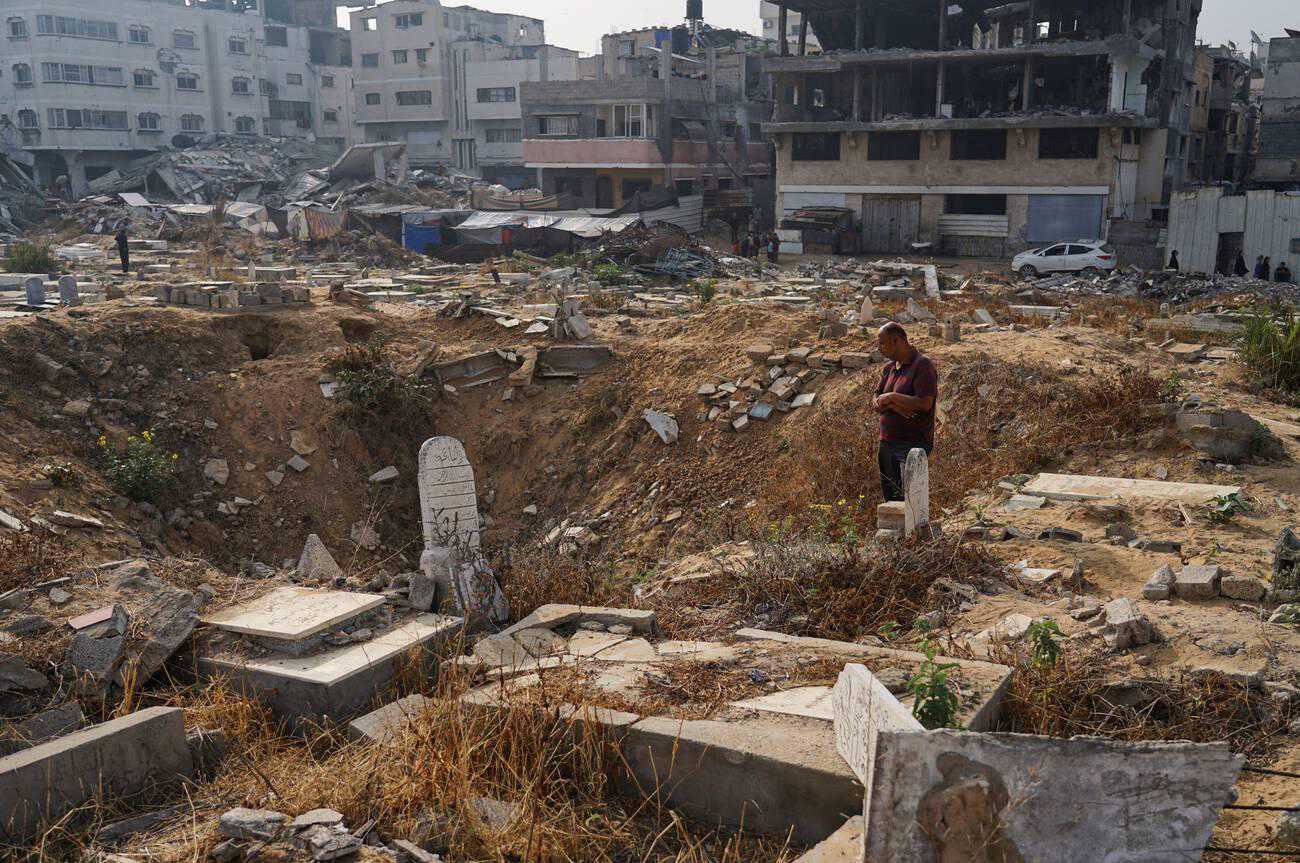
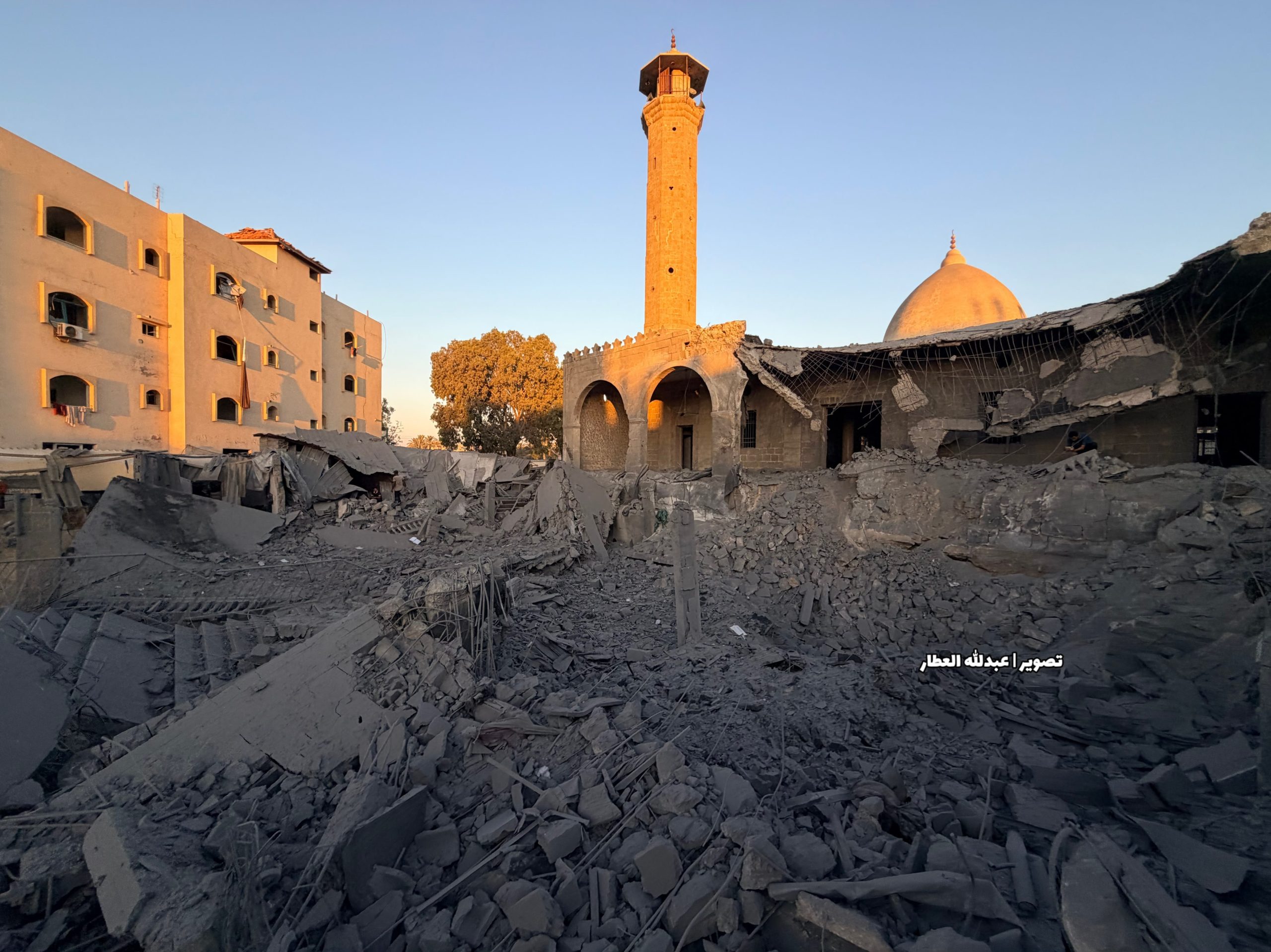
CROSSFIREARABIA – By August 2026, scarcely a mosque in Gaza escaped the war. Ancient Mamluk sanctuaries, neighbourhood prayer halls and modern mosques were reduced to rubble, while worshippers, imams and religious scholars killed. The scale raises a question that goes beyond battlefield damage: Were all these buildings legitimate military objectives, or has part of Gaza’s religious and cultural landscape been destroyed?
In Gaza today, the absence of the minaret has become almost as noticeable as the presence of the rubble.
For generations the skyline of Gaza City, Jabalia, Deir al-Balah, Khan Younis and Rafah was punctuated by domes and slender minarets. Mosques were not merely buildings entered five times a day for prayer. They were landmarks by which neighbourhoods identified themselves, places where families met, children studied the Quran, charitable committees distributed assistance and generations marked births, marriages and deaths.
After nearly three years of Israeli military attacks, much of that religious landscape has disappeared.
The latest figures supplied by Gaza’s Ministry of Awqaf and Religious Affairs and reported by the Palestine Information Center on 25 August 2026 state that 1,244 mosques out of the Gaza Strip’s 1,275 have been targeted since 7 October 2023. Of these, 1,077 have been completely destroyed.
That means roughly 98 percent of Gaza’s mosques have been struck or otherwise affected, according to the ministry, and about 84 percent of the entire pre-war stock of mosques has been completely destroyed.

The ministry says only a fraction of Gaza’s pre-war religious infrastructure is presently functioning normally. In August 2026 it reported 224 standing mosques and 428 temporary prayer spaces, many assembled from timber, canvas and whatever material could be salvaged from the ruins. Sixty-five damaged mosques had been provisionally made usable.
The figures have risen dramatically as the war has continued. In October 2024 the ministry reported 814 mosques completely destroyed and another 148 damaged. By February 2025 it said 834 were completely destroyed and 275 severely damaged. By August 2026 the complete-destruction count had risen to more than 1,070.
International organisations use more conservative figures because they count only sites they have individually verified. OHCHR reported that, according to the Gaza Ministry of Endowments, 995 mosques and three churches had been partly or completely destroyed by 31 May 2025. UNESCO, using satellite imagery and site assessments rather than accepting the entire ministry inventory, had independently verified damage to 164 cultural sites by March 2026, including important religious monuments.
The difference therefore does not necessarily mean one side is counting inaccurately. They are measuring different things: Gaza’s ministry is attempting a comprehensive administrative inventory, while UNESCO and other UN bodies generally record only individually verified cultural properties.
The assault began almost immediately
Some of the first mosques disappeared within 48 hours of the 7 October attacks.
At approximately 4:30 a.m. on 9 October 2023, Israeli warplanes struck the Sheikh Ahmed Yassin Mosque in Gaza City’s crowded al-Shati refugee camp. Human-rights documentation subsequently reviewed by Airwars says the four-storey mosque was completely destroyed and three civilians were killed — two women and a girl. Around a dozen others were reported injured.
Nearby, the Al-Gharbi Mosque was also destroyed. Palestinian documentation says several missiles struck the mosque and three civilians in the area were killed. Because several mosques in al-Shati were attacked in the same period, casualty attribution varies between reports.
Then came the Abdullah bin Omar, or Al-Sousi Mosque, also in al-Shati.
An Airwars investigation records that an Israeli airstrike at approximately 11:10 a.m. on 9 October destroyed the mosque, killing 10 to 11 civilians and injuring around 60. At least two children and several women, including a pregnant woman, were among the dead according to the sources it examined.

A joint appeal submitted by Palestinian human-rights organisations Al-Haq, Al Mezan and the Palestinian Centre for Human Rights to UN special procedures likewise recorded 11 civilians killed when Israeli aircraft struck Al-Sousi Mosque.
Other mosques reported struck during the opening weeks included Yarmouk Mosque, Abbas Mosque, Ishteiwi Mosque, Sheikh Shaaban Mosque, Shama’a Mosque, the Islamic University Mosque, Habib Muhammad Mosque in Khan Younis, Saad al-Ansari Mosque in Beit Lahia, Imam Ali Mosque in Jabalia, Al-Aqsa Martyrs Mosque in Nuseirat, Al-Omari Mosque in Jabalia, Anwar Aziz Mosque in Jabalia and Fatima al-Zahra Mosque in al-Zahra City.
These were not confined to Gaza City. From the first weeks the pattern stretched from Beit Lahia and Jabalia in the north, through Gaza City and the central camps, to Khan Younis and Rafah in the south.
Worshippers killed while gathered for prayer
One of the most disturbing characteristics of a number of attacks is their timing.
OHCHR has investigated the 15 November 2023 strike on Ihya al-Sunnah Mosque in the Sabra neighbourhood of Gaza City. The mosque was crowded with men and boys gathering for evening prayer.
The UN human-rights office says at least 63 Palestinians were killed.
More unusually, investigators were able to assess the probable weapon. OHCHR concluded that the strike was highly likely carried out with a precision-guided MK-83-class munition. The Israeli military did not publicly announce a target or justification for that particular attack, according to the UN investigation.
That distinction is important.
In most attacks on Gaza’s mosques it is possible to establish that an airstrike, artillery round, tank shell or demolition destroyed the structure. It is not possible to responsibly name the exact bomb model. Photographs of ruins alone rarely establish whether the weapon was an MK-82, MK-83, MK-84, GBU-series guided bomb or another munition.
Where there is forensic evidence, however, the picture becomes clearer.
The most notorious example came at Al-Tabaeen School and its mosque/prayer hall in Gaza City’s al-Daraj district on 10 August 2024.
Thousands of displaced Palestinians were sheltering in the compound. The strike came during Fajr, the dawn prayer.
Gaza Civil Defence ultimately reported more than 90 dead; early Palestinian government statements placed the figure around 100. Reuters reported the Civil Emergency Service’s estimate of about 100 deaths, while CNN reported at least 93.
CNN’s weapons analysis identified debris from at least one US-manufactured GBU-39 Small Diameter Bomb, a precision-guided weapon.
Israel acknowledged carrying out the attack. It said the prayer compound contained a Hamas and Islamic Jihad command-and-control facility and said militants were among those killed, while disputing the Palestinian casualty figure.
Palestinian officials and witnesses said the victims had assembled for dawn prayers.
Whatever the competing descriptions of those present, it remains one of the deadliest documented attacks on a place being used for Muslim worship during the war.
Deir al-Balah: Another mosque filled with displaced families
The Shuhada al-Aqsa Mosque beside Al-Aqsa Martyrs Hospital in Deir al-Balah became another refuge for Palestinians who had already lost their homes.
Shortly after midnight on 6 October 2024, Israeli aircraft struck it.
Safa reported 21 people killed in the mosque alone, with dozens wounded. In the combined attacks on the mosque and nearby Ibn Rushd School, Palestinian officials initially reported 24 deaths and 93 injuries; subsequent international reports put the combined toll at least at 26.

Israel confirmed attacking the Shuhada al-Aqsa Mosque structure, saying Hamas personnel were operating from a command centre embedded there. The military said it used “precise munitions”, surveillance and intelligence intended to reduce civilian casualties. It did not publicly identify the specific bomb model.
This is an important example of the central dispute surrounding many mosque attacks.
Israel says mosques lose their protection from direct attack when Hamas or Palestinian Islamic Jihad uses them for military purposes. Palestinians argue that Israel has repeatedly invoked this explanation without publicly presenting evidence sufficient for independent scrutiny, particularly where displaced civilians were known to be sheltering in the same buildings.
Rafah’s Al-Farouq Mosque
Southern Gaza was no sanctuary either.
On 22 February 2024, an Israeli airstrike flattened the Al-Farouq Mosque in Rafah’s Shaboura area. Photographs showed little more than slabs of broken concrete where the mosque had stood.
Reuters reported at least seven bodies brought out following that night’s attacks on the mosque and neighbouring houses. WAFA likewise reported seven Palestinians killed in the Rafah bombardment, although available reporting does not establish that every one of the seven was actually inside the mosque.
The distinction matters: In a densely built city, a bomb dropped on a mosque may kill people in the mosque, in adjacent houses or in the street. Casualty totals should therefore not automatically be assigned to the mosque itself unless eyewitness or medical documentation establishes the location.
Great Omari Mosque: Destroying layers of history
Human loss is only one dimension of what happened.
At the heart of Gaza City’s old al-Daraj quarter stood the Great Omari Mosque, Gaza’s most important historic mosque and one of the oldest religious structures in Palestine.
Its architecture was itself a history book.
The site carried layers associated with antiquity, Byzantine Christianity, the Crusader period and Islamic Gaza. Parts of the structure incorporated a Crusader basilica. Mamluk and Ottoman rulers enlarged and embellished it. Its façade preserved a Gothic-style entrance arch, while its courtyard, marble mihrab, sandstone masonry and distinctive minaret spoke to later Islamic architectural traditions. UNESCO describes it as an architectural fusion and one of the principal monuments demonstrating Gaza’s continuous sacred history.
The complex covered approximately 4,100 square metres and was built largely of local kurkar sandstone. Historical inscriptions recorded Mamluk rulers, while the mosque’s library held old books and manuscripts.
It was struck more than once.
ICOMOS Palestine documented damage to its minaret in November 2023 and a devastating second Israeli airstrike around 7 December 2023, which destroyed most of the main structure.
Photographs afterwards showed the minaret rising almost alone from mountains of stone.
The precise bomb used in the December attack has not been independently established. It should therefore be described simply as an Israeli airstrike, rather than assigning it a particular bomb type without forensic evidence.
The loss is greater than that of one mosque. UNESCO’s description of Gaza’s historic centre stresses that the Omari represented the city’s successive Byzantine, Crusader, Mamluk and Ottoman layers — material evidence that Gaza was never an ahistorical refugee enclave but a Mediterranean city with centuries of urban continuity.
Ibn Uthman: A Mamluk masterpiece disappears
Another extraordinary loss occurred in Shuja’iyya.
The Ibn Uthman Mosque, built in stages between the late 14th and early 15th centuries, was one of Gaza’s finest surviving examples of Burji Mamluk architecture.
Its courtyard, porticoes, domed mihrab and decorative stonework made it, after the Great Omari Mosque, one of the most celebrated historic mosques in Gaza. Inscriptions preserved the names of Mamluk patrons and even a 15th-century decree concerning taxation in Gaza.
An Israeli airstrike destroyed the mosque during fighting in Shuja’iyya in July 2024. UNESCO has since independently listed Ibn Uthman among Gaza’s damaged cultural properties.
A structure surviving approximately six centuries had disappeared in seconds.
Sayed Hashem and Gaza’s sacred geography
The Sayed Hashem Mosque was another landmark damaged in the opening months of the offensive.
Situated in Gaza City’s old quarter, it is traditionally associated with Hashem ibn Abd Manaf, the great-grandfather of the Prophet Muhammad (PBUH), who according to local tradition died in Gaza while travelling through the region.
ICOMOS Palestine reported the mosque damaged by Israeli fire during the war and identified it among the city’s important historic religious losses.
Its importance to Gazans therefore extended beyond architecture. The shrine helped give Gaza one of its traditional names, Ghazat Hashem — “Gaza of Hashem.”
Destroying or severely damaging such a building consequently affects not only contemporary worship but a place-name, a historical narrative and a community’s relationship with its city.
A mosque dating from 1951 becomes the latest casualty
The destruction has continued well beyond the first two years of the war.
On 24 August 2026, Israeli aircraft destroyed Abu Salim Mosque in Deir al-Balah, according to Gaza’s Ministry of Awqaf and the Palestine Information Center.
Built in 1951 by Hajj Muhammad Abu Salim, it was among the early mosques of modern Deir al-Balah and had become a centre for Quran classes and community and religious activities. The attack also destroyed the prayer hall of Asqalan Mosque in al-Shati camp, while the Al-Radwan Mosque prayer hall in western Gaza City sustained damage.
The exact munition used against Abu Salim Mosque has not been publicly verified.
Its destruction is significant precisely because it was not an imperial monument or medieval masterpiece. Heritage is also accumulated living memory: Weddings, funerals, Ramadan nights, children’s lessons and the voices of successive imams.
The imams and preachers who died
The destruction also followed Gaza’s religious personnel.
Gaza’s Ministry of Awqaf said early in 2024 that more than 100 scholars, preachers, imams, muezzins and Quran teachers had already been killed.
By 2026 the number was considerably higher.
Figures published by the Palestine Information Center in August 2026 said that by the end of 2025, 233 Muslim imams, preachers and religious educators and 20 Christian clergy had been killed. Other ministry figures published in February 2026 spoke of more than 330 ministry employees, religious scholars and imams killed across the broader religious establishment.
Among prominent religious figures killed was Sheikh Yusuf Salama, a former Palestinian minister of religious affairs and former preacher at Al-Aqsa Mosque, killed when his home in Maghazi refugee camp was bombed. The preacher and imam Wael al-Zard died of wounds after an attack on his home, while Walid Oweidah, who headed a Quran memorisation department in the Ministry of Awqaf, was also killed in an attack on his home in Gaza City’s Sabra district.
These cases must be distinguished from people killed inside mosques. The available evidence shows many religious personnel were killed in homes or elsewhere, rather than during the actual destruction of their mosque.
What bombs were used?
There is no credible evidence that a single type of bomb explains the destruction of Gaza’s mosques.

The documented methods include air-delivered precision-guided bombs and missiles, artillery fire, tank fire, bulldozing and controlled demolitions using explosives placed directly inside structures.
In several cases the exact weapon can be identified. OHCHR assessed the November 2023 Ihya al-Sunnah Mosque attack as highly likely involving a precision-guided MK-83 munition. CNN identified the remains of a US-made GBU-39 Small Diameter Bomb at the Al-Tabaeen mosque/prayer-hall strike according to a United Nations report.
Amnesty International found another category of destruction entirely: Buildings blown up after Israeli troops had gained control of them.
Its investigation verified 43 videos depicting attacks on 34 mosques and documented at least 12 mosques destroyed in controlled demolitions. Amnesty specifically examined the Al-Dhilal Mosque in Bani Suheila and Al-Istiqlal Mosque in Khan Younis, concluding that manually placed explosives were used while Israeli forces controlled the locations.
That evidence matters because a controlled demolition is fundamentally different from a split-second airstrike during active combat. The question of immediate military necessity becomes harder to answer when troops already control a building and have the ability to search, secure or isolate it.
Did Israel have a military purpose?
Israel says unequivocally that it did.
The Israeli military has published a series of statements alleging Hamas and Palestinian Islamic Jihad used mosques as weapons-storage facilities, meeting points, tunnel entrances and command centres. It says intelligence and material captured in Gaza demonstrated military use of “dozens of mosques.”
For individual attacks including Al-Tabaeen, Shuhada al-Aqsa and Al-Farouq, Israel has stated that militants or command structures were operating in or from the buildings.
International humanitarian law does not make a mosque immune under every conceivable circumstance. A place of worship being genuinely used for military action can lose its normal protection for the duration of that use. Even then, the attacking force remains bound by the principles of distinction, proportionality and precautions to protect civilians.
The harder question is whether a military explanation plausibly accounts for destruction on the scale documented in Gaza.
Here the evidence becomes much more troubling.
Amnesty International examined controlled demolitions in which Israeli troops appeared to be in physical control of religious and cultural properties and concluded in several cases that there was no evident imperative military necessity for destroying them. The organisation said the evidence suggested destruction itself may in some cases have been the objective.
OHCHR has reached similarly serious conclusions concerning the pattern rather than every individual strike. Its 2026 overview highlighted attacks during prayer times and reported that 17 mosques were struck during April 2024, including eight around Eid al-Fitr on 11 and 12 April. It said Israel had not presented evidence substantiating the loss of civilian protection for those places and concluded that the timing, weapons and pattern raised concerns that places of worship were either directly targeted or attacked without adequate precautions.
Those findings do not prove that every demolished mosque was intentionally attacked because it was a mosque. Nor do they establish that no mosque was ever militarily used.
They do, however, make it difficult to explain the destruction of virtually an entire religious landscape simply as incidental collateral damage.
More than buildings
International recognition of the cultural dimension has expanded as the ruins have accumulated.
A UN report noted the destruction or damage of the 800-year-old Sheikh Zakaria Mosque, the Great Omari Mosque and other important religious sites. UNESCO has independently confirmed damage to the Great Omari and Ibn Uthman mosques among the cultural properties it has monitored.
The Great Omari is now included within Gaza’s historic centre on Palestine’s UNESCO World Heritage Tentative List, which emphasises the survival in one urban landscape of Byzantine, Crusader, Mamluk and Ottoman architectural layers.
This is what statistics such as 1,077 completely destroyed mosques cannot convey.
A mosque is concrete and stone, but it is also sound: The dawn call to prayer; children’s voices reciting after school; a Friday congregation spilling onto the pavement; Ramadan evenings; neighbours meeting one another five times a day.
Destroy enough of them and something less visible is damaged — the system through which a community remembers itself.
That may explain why Gazans have begun erecting prayer spaces in tents and beneath sheets of plastic almost as quickly as the permanent structures disappear. By August 2026 Gaza’s Ministry of Awqaf said 428 temporary prayer spaces were operating across the Strip.
The minarets may have fallen, but the congregations have not disappeared.
And that leaves a question that any eventual investigation of the Gaza war will have to confront mosque by mosque, strike by strike:
What military necessity required each of these buildings to be destroyed — and where no such necessity can be demonstrated, was Gaza losing not merely a battlefield structure, but part of its religious history and collective memory?
The question becomes more urgent, not less, when the destroyed building is a 600-year-old Mamluk mosque, a packed prayer hall at dawn or a neighbourhood mosque built in 1951.
For Gaza, reconstruction will therefore involve more than replacing bricks.
It will mean reconstructing a landscape of worship, memory and history that, according to its own Ministry of Awqaf, has been almost entirely erased from the physical map of the Strip.
 marwan