War and The Blame Game

By Khairi Janbek

Undoubtedly, the blame game is not a concept limited to the Middle East, neither the notion of who started the conflict nor who will end it.

However in this context, one wishes to talk about the current conflict which is becoming a chaos beyond the Middle East and specifically about Iran and its contribution to this chaos. Going back, and from the onset of the Iranian Revolution of 1979, chaos has always been part and parcel of its revolutionary ideology, reviving the old Shia-Sunni conflict, attempting to be the representative of the Shia of the world; most importantly, the concept of export of the revolution whenever the opportunity comes around.

But this phase ended with the end of the war with Iraq, but saying ended may well be too deterministic, because chaos under Iranian sponsorship emerged again after the fall of the Saddam Hussein regime in the form of what became known as the Iran-dominated Shiite Crescent. However with the set backs of last year, the chaos sponsorship of Iran to a back step, to relaunch again with projectiles all around creating a chaos in the region and beyond.

Essentially at this juncture, all the affected countries seem to have left the conflict to Israel and the US to deal with, maybe to the possibility that those parties do not believe that this conflict will be conclusive, or a feeling that whether they participate in the conflict or not, they will neither be seen in good favour by the United States and/or Israel.

But also having said that, there is also plenty of scepticism in the region, because each time there is a conflict involving the USA, there is always a big possibility that the US stops in the middle and allows its adversaries to recover and pick up, which means putting themselves in an adversarial position vis a vis recovered forces which they may have to face.

In fact whether by fluke or by good thinking, not to declare the war aims in this conflict may turn out to be a wise move, as this war may indeed end as one is writing these words, with the declaration by everyone that the war aims have been achieved. But as a final word, one feels Iranian induced chaos must be met with a world response.

Dr Janbek is a Jordanian columnist based in Paris, France.

Continue reading
Iran Strikes Israel 200 Times on Day 1 of War

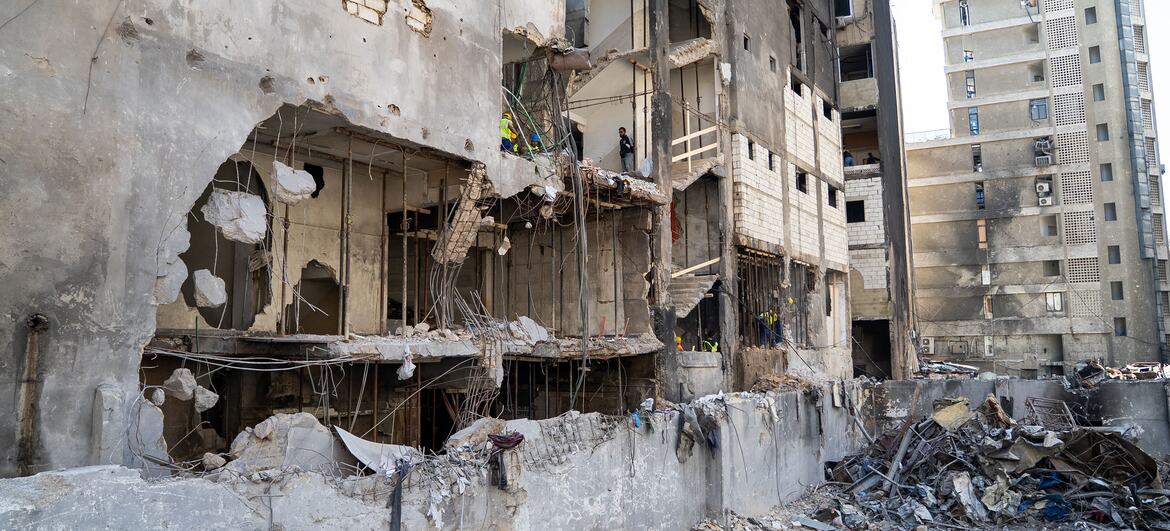
Israeli emergancy services stated, Saturday night, 89 people were injured as a result of the Iranian attacks while the Hebrew media (Channel 13) reported that Tehran launched more than 200 strikes on the different parts of the Jewish entity on the first day of the US-Israeli war launched on Iran. The Israeli media (Channel 12) reported that central Israel suffered much material damage from the Israeli missiles that launched on Israel despite the fact tenss of these were deflected by Israeli batteries. Yedioth Ahronoth reported injuries in the city of Bnei Brak, near Tel Aviv though it didn’t say how critical these were. The Hebrew Channel 12 reported the number of fires were caused in northern Israel. Air raid sirens were reported in many parts of the country as ringing all day because of the incoming missiles with millions of Israelis taking to underground shelters.

Continue reading
UN Condemns US/Israel Attacks on Iran

UN Secretary-General António Guterres and the heads of UN agencies have condemned Saturday’s joint Israeli and US attacks on Iran and the Iranian retaliatory strikes on Israel and the Gulf Regions.

The attack on Iran reportedly targeted military sites as well as the leadership of the Iranian regime. Explosions were heard in Israel and Gulf countries after Iran launched a wave of drones and missiles.

Mr. Guterres declared that the military escalation in the region undermines international peace and security, and recalled that all Member States must “respect their obligations under international law, including the Charter of the United Nations,” which prohibits “the threat of the use of force against the territorial integrity or political independence of any state, or in any other manner inconsistent with the Purposes of the United Nations.”

 The UN Chief called for an immediate cessation of hostilities and de-escalation and warned that a failure to do so risks a wider regional conflict with grave consequences for civilians and regional stability. 

Risk of ‘destruction on an unimaginable scale’

Senior officials added their own responses on Saturday morning: Volker Türk, the High Commissioner for Human Rights said that bombs and missiles are not the way to resolve differences but “only result in death, destruction and human misery.” Civilians, he noted, “end up paying the ultimate price.”

Mr. Türk called for all parties to return to negotiations in order to avoid a wider conflict that would mean further civilian deaths and “destruction on a potentially unimaginable scale, not just in Iran but across the Middle East region.”

World Health Organization (WHO) Director-General Tedros Adhanom Ghebreyesus said in a statement that he was deeply troubled by the situation and urged leaders to “choose the challenging path of dialogue over the senseless route of destruction.” 

Emergency Security Council meeting scheduled

Security Council meeting to discuss the attacks has been called by French President Emmanuel Macron. The meeting is scheduled for 4PM Eastern Time on Saturday.

Follow the meeting live on UN News and on UN WebTV

Reactions from across the UN system

  • António Guterres, UN Secretary-General“I condemn today’s military escalation in the Middle East. The use of force by the United States & Israel against Iran, and the subsequent retaliation by Iran across the region, undermine international peace & security.”
  • Tedros Ghebreyesus, Director-General, World Health Organization (WHO)“I am deeply concerned about the current situation in the Middle East. My heart is with the civilians caught in the crossfire.”
  • Volker Türk, High Commissioner of Human Rights“As always, in any armed conflict, it is civilians who end up paying the ultimate price.”
  • Annalena Baerbock, President of the General Assembly“The UN Charter is clear: all Member States must settle their international disputes by peaceful means in such a manner that international peace and security, and justice, are not endangered.”
  • International Atomic Energy Agency“The IAEA is closely monitoring developments in the Middle East, and urges restraint to avoid any nuclear safety risks to people in the region.” – UN News

Continue reading
Netanyahu’s Middle East Vision

By the end of December, Israeli Prime Minister Benjamin Netanyahu is expected to visit Washington to meet US President Donald Trump, marking his fourth visit in less than a year since Trump assumed office. Unlike previous visits, this one comes after President Trump imposed his vision for ending the war in Gaza and outlined his broader concept of regional peace—giving the visit a distinctly political dimension.

At the core of the discussions will be the transition to the second phase of the Gaza ceasefire agreement, the appointment of an American general and a monitoring center, and the mechanism for administering Gaza ahead of the arrival of an international peace force. The visit is also expected to address Israel’s relations with its regional surroundings, particularly Egypt. Reports suggest the possibility of a simultaneous visit by the Egyptian president to Washington, reflecting a clear American desire to initiate direct engagement and promote the concept of “economic peace,” along with major regional projects that Trump views as the backbone of future relations, especially in the energy and gas sectors.

Yet even as President Trump speaks of a regional peace vision, the days preceding the visit remain open to further escalation. Indicators point toward a qualitative Israeli escalation across four fronts: Gaza, the West Bank, Lebanon, and Syria. These fronts have been deliberately kept open, transformed into continuous theaters of operation where Israel calibrates the level of military activity according to its security assessments.

Lebanon remains the most prominent arena of this escalation. Ongoing discussions about Hezbollah’s efforts to rebuild its capabilities coincide with Israel’s continued direct targeting of the group’s positions and operatives. This comes amid growing American pressure on the Lebanese government and army to take concrete steps toward disarming Hezbollah.

While the group is fully aware of its inability to engage in a comprehensive regional war, and the need to avoid providing direct justifications for escalation, it nevertheless finds itself compelled to use the weapons issue domestically to reshape internal power balances. At the same time, Hezbollah seeks to secure the future framework of its relationship with Syria, particularly if the Syrian-Lebanese border shifts from being merely a site of interdiction to a direct target zone.

This reality severely constrains Hizbollah’s response options while granting Israel continued latitude to strike the group’s infrastructure, capitalising on the absence of a decisive resolution to the weapons issue and on Lebanon’s institutional confusion over how to address it, whether through phased timelines or alternative formulas such as placing weapons under army control. From Israel’s perspective, this ambiguity justifies continued targeting until a decisive moment is reached.

Within this context, Israel’s strategy of imposing a new reality across its border fronts aligns closely with the transition to the second phase of President Trump’s plan. This approach corresponds with Israel’s efforts over the past two years to redraw geographical and security realities in Syria, Gaza, Lebanon, and even the West Bank. While the Trump administration opposed a formal declaration of annexation in the West Bank, it did not object in practice to Israel’s on-the-ground measures, allowing these changes to solidify as irreversible facts.

Security measures taken today may therefore establish realities that will be difficult to reverse in the future. From Washington’s perspective, redrawing borders may be seen as laying the groundwork for what it terms “regional peace,” treating the new border realities as spaces for potential economic or developmental investment.

Netanyahu’s visit to the White House thus represents a pivotal moment. He will seek to position himself as a central actor in the next phase, consolidate new realities along Israel’s immediate borders, and secure U.S. backing in addressing non-adjacent fronts, most notably Iraq, and above all Iran.

Iran is left to grapple with an increasingly severe internal reality marked by mounting economic, social, service-related, and security challenges, and is simultaneously categorized as part of the camp of “obstructors of regional peace” in Trump’s framework, opening the door to intensified pressure and varied forms of targeting in the period ahead.

Dr Amer Al Sabaileh, a professor in the University of Jordan contributed this analysis to the Jordan Times.

Continue reading