‘Yes, it is Genocide,’ Leading Israeli Author Says

David Grossman, one of Israel’s most prominent authors, told Italian daily La Repubblica he has decided to start using the word “genocide” to describe the situation in Gaza.

“For years, I refused to use the word ‘genocide.’ But now I can’t hold back from using it, after what I’ve read in the newspapers, after the images I’ve seen and after talking to people who have been there”, he said in the interview published in the paper’s print edition on Friday.

Grossman said coming to the realization that Israel is committing genocide in Gaza was an extremely painful process on a personal level, but that he now found such conclusion inescapable.

“I want to speak as a person who has done everything he could to avoid having to call Israel a genocidal state. And now, with immense pain and a broken heart, I have to say that it is happening before my eyes. Genocide,” he said.

The Israeli writer went on to say he now feels a moral obligation to speak up. “I feel an inner urgency to do the right thing, and now it is the time to do it,” Grossman said.

Asked by the journalist about the spiraling death toll in Gaza, he said: “I feel sick. Even though I know that those numbers are controlled by Hamas and that Israel cannot be solely responsible for all the atrocities we are witnessing. Nevertheless, reading in the newspaper or hearing in conversations with friends in Europe the juxtaposition of the words ‘Israel’ and ‘hunger’; to do so starting from our history, from our supposed sensitivity to the suffering of humanity, from the moral responsibility we have always claimed to have towards every human being and not only towards Jews… all this is devastating”, he said.

Grossman’s words come amid growing condemnation of Israel for its actions in Gaza on the international stage, and as several countries, including France and Britain, have pledged to recognize a Palestinian state in the near future.

Palestinians receive food at an aid distribution hub in Gaza City, Friday.

The use of the word genocide to describe Israel’s war in Gaza is also becoming more common in international intellectual circles.

In mid-July, an opinion piece titled “I’m a Genocide Scholar. I Know It When I See It” in the New York Times by Professor Omer Bartov, an Israeli professor of Holocaust and genocide studies at Brown University, made the case for the use of the word genocide.

Grossman, who is one of Israel’s most well-known writers abroad, has long been a vocal critic of Israel’s occupation of Palestinian territories. The editor of The New Yorker, David Remnick, recently described him as “the only [living Israeli] novelist with comparable moral authority” to that of the late Amos Oz. In the interview in La Repubblica, he reiterated that he considers Israel’s occupation of the West Bank and Gaza after the Six-Day War as a key watershed moment in the country’s history.

“I am absolutely convinced that Israel’s curse began with the occupation of the Palestinian territories in 1967. Perhaps people are tired of hearing about it, but that is how it is,” he said.

Grossman also noted it is critical to ensure those harboring antisemitic sentiments do not “use and manipulate” the word genocide. He also criticized Hamas for turning Gaza into a base for launching rockets into Israel in the aftermath of Israel’s withdrawal in 2005.

“The Palestinians’ big mistake is that they could have turned the Strip into a thriving place, but instead they gave in to fanaticism and used it as a launching pad for missiles against Israel”, he said.

“If they had made the other choice, perhaps this would have prompted Israel to also give up the West Bank and end the occupation years ago”, he said.

Grossman also added that many around the world still fail to understand the magnitude of the trauma of October 7 for Israelis.

“Many people still don’t understand what it meant for us. Many people I know [in Israel] have abandoned our common left-wing values since that day; they have given in to fear, and suddenly their lives have become easier, they feel accepted by the majority, they no longer need to think,” he said.

Grossman considers resettling Gaza, as some Israeli ministers advocate, wrong and self-defeating. “I hear people like Smotrich and Ben-Gvir saying that we must rebuild settlements in Gaza, but what are they saying? Don’t they remember what happened when we were there, with Hamas killing hundreds of Israeli civilians, women and children, without us being able to protect them? We did not leave Gaza out of generosity, but because we could not protect our people”, he argued.

Looking forward, Grossman said he remains a believer in the two-state solution. As such, he praised French President Emmanuel Macron’s decision to recognize a Palestinian state, that was followed by similar statements by other leaders. “I don’t understand the hysteria it has provoked here in Israel”, he said.

Finally, Grossman rejected accusations that Israel’s cultural elites should have taken a stronger stance on what is happening in Gaza a lot faster. “I believe that targeting those who have fought the Occupation for 70 years, who have invested most of their lives and careers in this battle, is unfair”, he concluded.

Haaretz

Continue reading
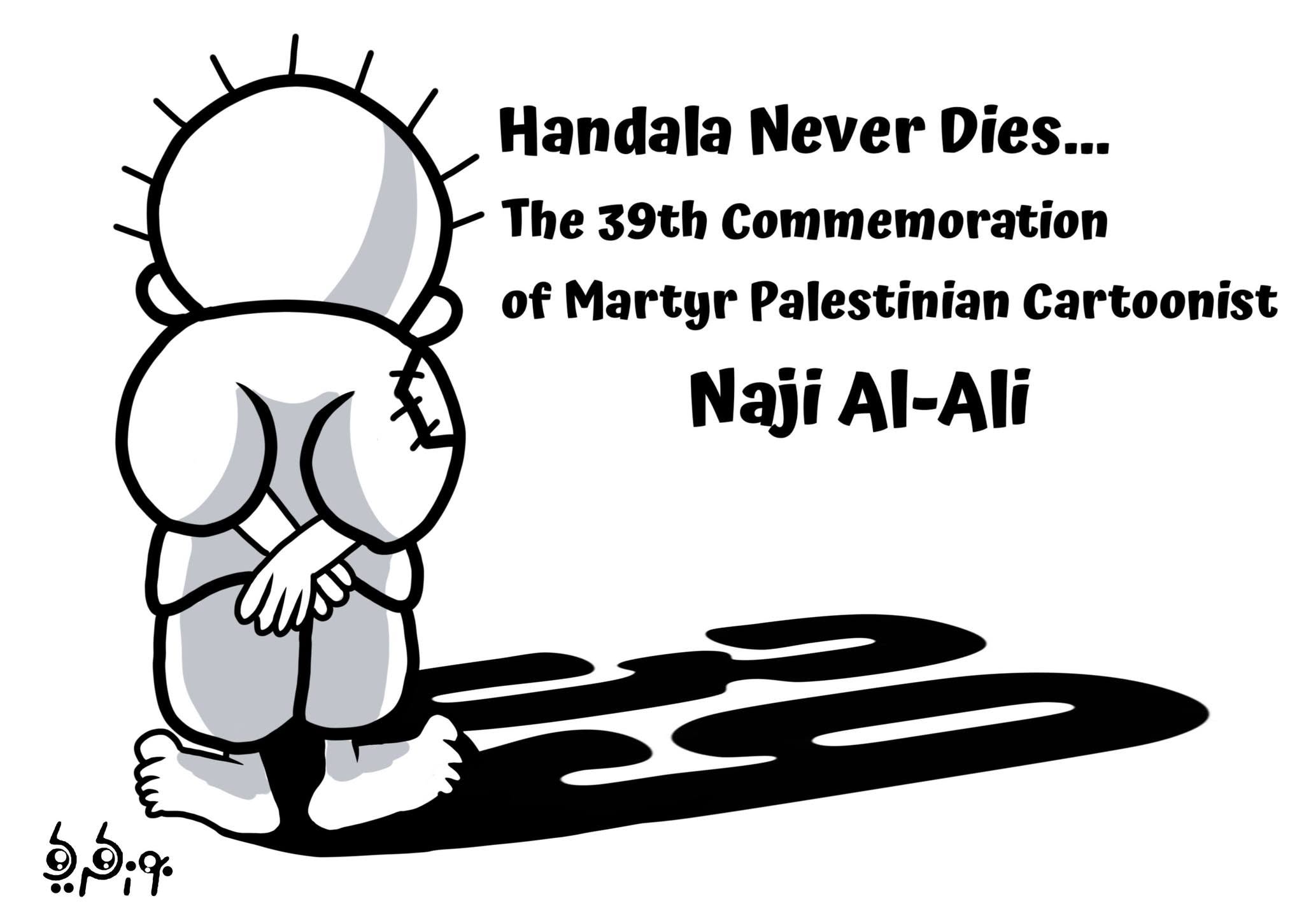
Hanthala Outlasts Naji Al Ali as He Predicted

By the time he died on August 29, 1987, he had a collection of 40,000 cartoons. Naji Al Ali, the famous Palestinian cartoonist, had been in a coma for five weeks after being shot in the head by a gunman outside the London offices of Al Qabas newspaper on July 22.

Although till now nobody is certain of who killed him, Al Ali’s death was a result of decades of rebelliousness against the Arab status quo, his longing for change in Arab society, and the introduction of democracy.

He felt this would be translated into political strength to fight for the return of Palestine. Al Ali had the knack of weaving politics and culture together. His drawings had distinct messages: they were contextual, fighting against injustice and oppression in the Arab world.

Naji Al Ali was one of a kind. In few simple lines, he could depict the drama of a whole population and convey messages sometimes so sharp and rich in symbols that the viewer’s attention was effortlessly drawn to understanding the hidden meanings.

Though his messages were politically-driven, he always maintained he was apolitical and that politics did nothing for him.

This is despite the fact that his life had come to be dictated by a series of political actions. His expulsion, along with his family, to Lebanon in 1948, and ending up in Ain Al Hilweh camp, was but the first of these actions. Al Ali was only 10 or 11 when he was forced out of Shajara, a village of 400 that were destroyed by Israel.

Given a chance

In the 1950s, before being given the chance to go to Kuwait, his life was immersed in politics. He took part in demonstrations and served time in Lebanese jails. During this time, he started drawing on the walls of the camp and in prison.

“I felt within me a need for a different medium to express what I was going through,” he used to say. He often said he felt it was harder to censor a cartoon than an article. Al Ali’s talent was first discovered by Ghassan Kanafani, the Palestinian writer and activist killed by the Israelis in the early 1970s. He was visiting the camp at the time, came upon Al Ali’s work, took a sample and latter published them in Al Hurriya, the magazine he was working for.

This may have given Al Ali the opportunity to work in Kuwait in 1964 at the Al Talieh magazine, a now well-established weekly, representing the voice of the nationalists. There, he made his professional career as a cartoonist, though he did other things as well. In 1971 he returned to Lebanon where he worked in the well-respected Al Saffir.

It was in Lebanon he found the best and most productive years of his life, he would later write. “There, surrounded by the violence of many an army, and finally by the Israeli invasion (1982), I stood facing it all with my pen every day, I never felt fear, failure or despair, and I didn’t surrender. I faced armies with cartoons and drawings of hope and flowers, hope and bullets.”

But, contrary to this cheerful attitude, one also felt there was a degree of anger, mixed with cynicism and despair within Naji Al Ali that always prompted him in his cartoons; it was the failure of action, of ineptitude and the lack of Arab resolve.

That’s why he may have created the Hanthala cartoon that always came to appear in his sketches from the 1960s onwards. In fact, in an almost perceptive vision of his death, Ali would say Hanthala would outlast him and would live long after he was was dead.

Hanthala, whose name means bitterness in Arabic , represents the aspirations of the camp refugees and the right of return. We never see his face as he is never shown facing the reader.

Naji Al Ali described him as a bare-footed child with spiky hair, with his hands firmly clasped behind his back as a symbol of rejection to what happened to the Palestinians. He will only turn his head, when Palestine is regained. Hanthala will remain 10 years old until he returns to the homeland, when he will start growing up again.

After 1982, Naji Al Ali went back to Kuwait to work in Al Qabas, but there was no let down in his political message. In 1985, he was expelled, but continued to work in the newspaper’s London office.

His cartoons continued to appear in many daily newspapers across the region in Kuwait, United Arab Emirates, Egypt, Tunisia and Lebanon.

Did Al Ali’s untimely death at the age of 51, mean Hanthala will never turn his head, or will he wait for someone to redraw him.

Whichever the case, and in the spirit of his creator, he will continue with his back to the audience until Palestine is liberated.

This article, written by me, is reprinted here from the archives of Gulf News.

Continue reading
Ziad Al Rahbani: Musical Icon

Ziad Al Rahbani, dubbed as the soul of Lebanon dies at the age of 69.

Sondoss Al Asaad wrote:

He was a revolutionary artist who combined musical and theatrical genius, boldly addressing themes of identity, politics, and resistance.  His first literary work was published at the age of 12 in the late 1970s. 

Jordanian Cartoonist Nasser Al Jafari sketched out this cartoon in the honor of the late artist.

“This is what musician , researcher Louis Brehony wrote about him in the Palestine Chronicle: It is with shock at the earliness of his departure Lebanon bids farewell to Ziad al-Rahbani, a pillar of radical musicianship, at the age of 69. A committed communist who aligned himself with the Palestinian cause, Ziad left his indelible musical fingerprints on a wide region. An essential influence to generations of listeners, musicians and activists, Ziad ruffled the feathers of the wealthy, embarrassed conservatives and irritated liberals. Son of Lebanese icons Fairuz and Assi Rahbani, his musical tenacity and critique of a system in crisis demanded that others sing for its downfall.

Born into relative privilege among Maronite Christians and well-known musicians, Ziad understandably trod a creative path from an early age. His composer father Assi and uncle Mansour were the famous Rahbani brothers, writing epochal works for his mother Fairuz, to this day Lebanon’s most renowned vocalist. Ziad grew up sitting in on rehearsals and met huge figures in Arab music, including Egyptian composer Mohammed Abdel Wahab and Palestinian Sabri Sherif, who produced Fairuz’s albums dedicated to Palestine. Ziad eventually inherited the Rahbani mantle and, from the 1980s, became Fairuz’s main songwriter.

As a teenager, Ziad joined Rahbani brothers’ productions and quietly applied his skills as a composer and keyboardist. Though his approach towards his parents’ legacy was not the scorched earth policy some describe, Ziad began to forge his own path. Attracted to leftist politics at a time when the Lebanese Communist Party (LCP) allied itself to Palestinian resistance, Ziad’s empathy with the poor and downtrodden quickly expressed itself through music. He found his raison d’être in musical theatre, and works like Film Amriki Tawil (Long American Film, 1980) and Shi Fashil (Failure, 1983) broke social taboos, sharply attacking class discrimination and spotlighting characters from the working class…’

Continue reading
Israel Loses Michael Cane

Well-known English actor Michael Caine finally cuts through the silence, showing sympathy for the children of Gaza who are being starved to death due to the ongoing, crippling Israeli siege on the Strip.

“Feed the children of Gaza, no child should be starving,” he rebukes Israel.

https://x.com/andres20ad/status/1948757483477958735

Continue reading
Rome Fountain Dim Lights For Gaza

Rome dimmed the lights of the iconic Trevi Fountain for one hour Friday night in a symbolic call for a ceasefire in the Gaza Strip, following a city council resolution last month that was titled, “Rome will not remain silent.”

“Let’s stop the war in Gaza” was also projected onto the front facade of the historic Palazzo Poli, which is behind the fountain, in a symbolic demand for a ceasefire.

A group of pro-Palestinian demonstrators gathered in front of the fountain and waved Palestinian flags in protest of what they described as genocide by Israel in Gaza.

The projected message referenced “war,” but demonstrators held signs that read: “What’s happening in Gaza is not a war, it’s genocide.”

Some chanted slogans accusing Israel of committing atrocities against Palestinians worse than those perpetrated by Nazi Germany against Jews during World War II.

They also criticized the US and the EU for being complicit in their silence.

The group shouted “Free Palestine”, “Stop the genocide” and “From the river to the sea, Palestine will be free.”

The demonstration drew attention from tourists, with some showing support with the pro-Palestinian group according to Anadolu.

Continue reading