Trump’s War Through Politics

By Dr Amani Al-Qarm

About 2,500 years ago, there was a Chinese general named Sun Tzu, renowned for his military genius and unique philosophy on achieving decisive victory. He compiled his vision in a famous book called “The Art of War.” Sun Tzu states in his book that subduing the enemy without fighting is better than winning a hundred battles, and that a skilled commander feeds on his enemies.

This means exploiting the enemy’s resources, weaknesses, and even strengths, striking at their strategy and alliances, and besieging them to achieve victory, rather than relying solely on one’s own resources. In other words, achieving victory at the lowest cost is preferable to destroying a country, and capturing the head of state is better than killing him.

The Trump administration’s slogan, “Peace Through Strength,” is not new to American administrations, but it was perhaps more blatant and explicit during Trump’s presidency, as was the case with everything else under his rule: no embellishment, no lofty phrases, no justifications to appease hypocritical Western arrogance, such as democracy and human rights. There are only declared and clear objectives: oil, minerals, money, and control without cost.

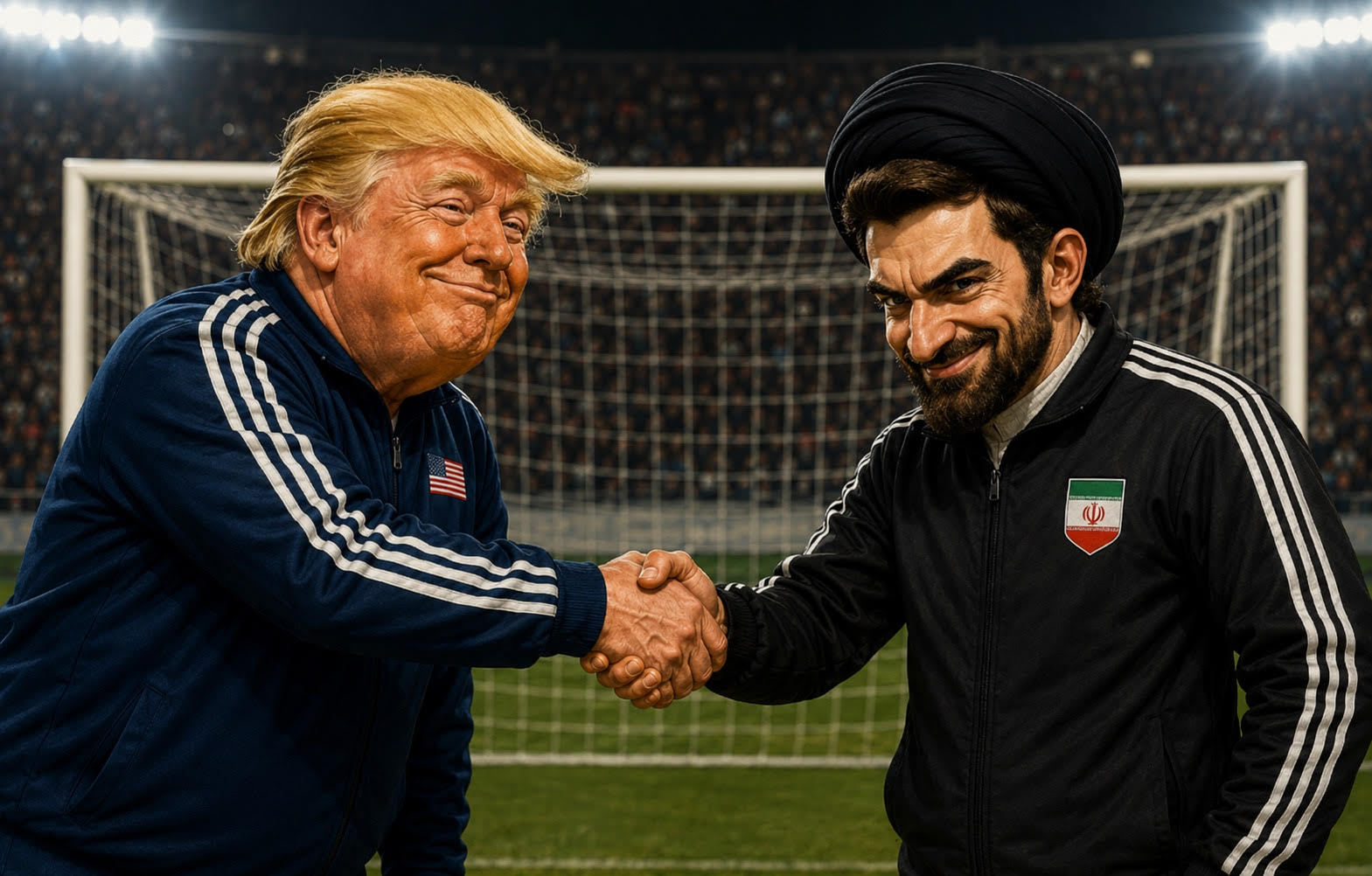
The entire world is watching the current unique American approach to dealing with the Islamic Republic of Iran. Just when the world expected an American strike on Iran, the door was opened for negotiations under the auspices of the massive aircraft carrier USS Lincoln and its destroyers and missiles stationed in the Arabian Sea.

This leaves allies and adversaries alike bewildered and unable to predict the outcome, while Trump maintains the element of surprise and the timing of the strike. It seems that Trump is not content with the slogan “Peace Through Strength” alone, but has added to it some of the principles of General Sun Tzu’s doctrine. Trump Feeds on His Enemies:

Iran is in a state of weakness unprecedented in decades. Internally, the country is seething with poverty and oppression, and the recent protests are unlike any before. Internal affairs are no longer purely domestic; they now carry external costs, given the threats the US president has made against the Iranian regime throughout the past month.

Furthermore, the country is strategically exposed. Its alliances have been shattered, and it and those who deal with it economically and militarily are besieged. The time is ripe to pounce on the prey. And because, as Tzu said, subduing the enemy without cost is better than winning a hundred battles, Trump has opened the door to negotiations to achieve his objectives.

What does Trump want from Iran? Is he negotiating to restore relations between the two countries? Or to liberate the Iranian people? Of course not. He seeks victory without a fight. The collapse of the country as a result of war would transform it into scattered chaos throughout the region, as has already been witnessed in Iraq, Libya, Yemen, and Syria.

Therefore, containing it to the greatest extent possible and completely changing its hostile behavior since 1979 is preferable to destroying it. And to strip it of everything it considers its sources of power: eradicating any nuclear ambitions, eliminating its missile program, and reducing its regional role to the bare minimum, while also constantly reminding it that America is serious and ready to confront it. From America’s perspective, qualitative and nuclear superiority should belong only to Israel in the region.

What happens next depends on Iranian behavior. Will it submit and be pragmatic, as it has been in the crises that have characterized its relationship with the United States since 1979, or will the Iranian regime feel that this crisis is existential, thus raising the voice of ideology where there is no turning back?

This article is republished from the Arabic Al Rai Al Youm website.

Continue reading
Netanyahu Leaves Washington Empty-Handed

By Mohammad Al-Kassim

Israeli Prime Minister Benjamin Netanyahu returned from Washington without the outcome he had clearly hoped for, or the outcome he had led his domestic audience to expect in the days before the trip.

The visit, hastily moved up by a week and framed by Netanyahu as urgent and decisive, ended with a brief, anodyne statement from his office. There was no joint appearance, no press conference, and no public declaration of alignment with President Donald Trump on Iran. 

When Netanyahu met with Trump at the White House on Wednesday, Iran was top of the Israeli PM’s agenda. And on his way back to Israel, Netanyahu said he had made his feelings clear – “not hide my general scepticism about the possibility of reaching any agreement with Iran”. 

For a leader who typically amplifies diplomatic achievements and personal rapport with American presidents — from his 2015 address to Congress opposing the Obama administration’s Iran deal to his close partnership with Trump during the Abraham Accords — the restraint was striking.

President Trump, for his part, said “nothing definitive” had been decided. 

The White House made clear that negotiations with Iran remain ongoing following the first exploratory round of US–Iran talks aimed at testing parameters for a possible new nuclear framework. 

That, in itself, was the headline Netanyahu had hoped to prevent.

Meeting defined by what didn’t happen

Netanyahu arrived in Washington, saying he would present Israel’s “guiding principles” for negotiations with Iran. 

But there was nothing fundamentally new in those principles — nor in the message he delivered.

For more than three decades, Netanyahu has framed Iran as an existential threat to Israel, warning of its nuclear ambitions in international forums, including at the United Nations General Assembly in 2012, where he famously drew a red line on a cartoon bomb.

His objectives have been consistent: weaken Iran by any means available; prefer regime change if possible; and, failing that, ensure Iran is permanently deprived of nuclear capabilities and long-range missiles.

After last year’s direct, unprovoked Israeli attack on Iran, missile capabilities have become even more central to Israel’s demands.

In Washington, Netanyahu pushed a maximalist position:

  • no uranium enrichment on Iranian soil, a demand that goes beyond previous US negotiating frameworks, including the 2015 Joint Comprehensive Plan of Action, which permitted limited enrichment under strict monitoring;
  • strict limits — ideally elimination — of Iran’s ballistic missile programme, a core pillar of Tehran’s deterrence strategy and long considered non-negotiable by Iranian leadership;
  • constraints on Iran’s regional allies and proxy networks, and
  • Israeli freedom of action to strike Iran, even under any future agreement.

He also opposes any ‘sunset clause’ seeking permanent restrictions that would entrench Israel’s strategic dominance in the region.

None of this aligns with the trajectory of US–Iran diplomacy. 

While the Trump administration has yet to spell out the precise parameters of a potential agreement, early signals from Washington point to a more limited objective than Israel has been demanding. 

The focus appears to be on extending Iran’s nuclear breakout timeline and preventing weaponisation — rather than eliminating uranium enrichment altogether or dismantling Iran’s ballistic missile programme.

In effect, the White House seems to be testing whether an imperfect but enforceable deal is achievable before turning to escalation. 

That approach reflects a calculation that containing Iran’s nuclear advances, even partially, may be preferable to the risks of confrontation or military action.

At the same time, President Trump has sharpened his rhetoric. 

He reiterated his commitment to negotiations but paired it with a stark warning: if Iran fails to reach a nuclear deal with Washington, the outcome would be, in his words, “very traumatic”. 

For the first time, Trump also attached a timeframe to that ultimatum, suggesting that diplomacy has a limited window — roughly the next month — before consequences follow.

The message from Washington is deliberate ambiguity: diplomacy remains the preferred path, but the clock is now publicly ticking.

The timing of Netanyahu’s trip is critical. Netanyahu advanced the visit shortly after the first round of US–Iran talks, signalling urgency — and concern. 

Israeli officials feared momentum: that negotiations might move ahead before Israel could shape their parameters.

That fear appears well-founded. While Trump continues to issue rhetorical threats toward Iran, his actions suggest a preference for testing diplomacy before escalating militarily. 

Domestic pressures and political stakes

Netanyahu’s urgency is also driven by domestic considerations. 

His governing coalition faces mounting pressures, including disputes over military conscription exemptions for ultra-Orthodox parties, budget constraints linked to prolonged wartime expenditures, and ongoing public dissatisfaction following the October 7 attacks and subsequent regional escalation. 

A dramatic confrontation with Iran — or even the perception that he is leading one — would be politically transformative.

Iran remains one of the few issues in Israel that still commands near-consensus across coalition and opposition lines. 

Netanyahu knows that. He has long positioned himself as the indispensable guardian against Tehran, and he needs to show Israeli voters that Washington remains closely aligned with him.

That explains the repeated emphasis, aimed at domestic audiences, on “coordination” with the US — even when public evidence of such coordination is thin.

According to Israeli assessments, Netanyahu brought intelligence to Washington intended to cast doubt on Iran’s intentions, including claims that Tehran is stalling negotiations, continuing executions, and refusing to engage seriously on missiles.

But if this intelligence was meant to derail diplomacy, it appears not to have succeeded.

Trump’s team — including Steve Witkoff, Jared Kushner, Marco Rubio, and others — listened. 

But the White House has not embraced Israel’s conclusion that negotiations are futile. 

Instead, it appears determined to test whether a deal is possible, even if imperfect. That leaves Israel preparing for an alternative outcome.

The prevailing assessment in Israel is that talks may ultimately fail — either because Iranian demands prove incompatible with US red lines, or because Israel’s demands make an agreement politically or technically impossible. 

That is precisely why Netanyahu insists on keeping the military option alive.

Behind closed doors, the three-hour meeting likely went beyond negotiating positions to contingency planning: what happens if talks collapse, how far Israel can act independently, and what level of US support or tolerance it might expect.

Israel’s core demand remains unchanged: freedom of action.

Despite public expressions of unity, Netanyahu and Trump are approaching Iran from different strategic premises. 

Trump appears to value flexibility and leverage, using the prospect of force to extract concessions while keeping diplomatic channels open. 

Netanyahu seeks permanence: structural constraints that prevent Iran from re-emerging as a threshold nuclear power under any future political configuration.

What binds them — at least for now — is political self-interest. Both prefer to avoid public confrontation. Both face domestic calculations. And both understand the risks of escalation.

For Netanyahu, however, the Washington visit underscored an uncomfortable reality: Israel can influence US policy, but it does not control it.

Diplomacy is moving forward — whether Israel likes it or not. – TRTWorld

Continue reading
‘Things No One Knew About Saif al-Islam’

By Raouf Qubaisi


I was deeply saddened by the death of Saif al-Islam Gaddafi, who was assassinated by ruthless and heartless individuals recently. I knew Saif al-Islam from many gatherings in London with friends, including his advisor and relative, Dr. Abdullah Othman, and the Libyan intellectual, Dr. Abdul-Muttalib al-Houni, whom I called at his residence in Rome to offer my condolences on Saif’s death.

Saif al-Islam was humble, friendly, and an astute opponent of his father’s policies. I was the one who arranged an interview for him with the Sunday Times, conducted by the esteemed Lebanese journalist and friend, Hala Jaber, which the prestigious British newspaper published on its front page.

In that interview, Saif said that “Libya needs a new administration.” This statement, as I recall, was the title of the interview, and it provoked the ire of his father, the Colonel, and the anger of his brothers and the elders of his tribe, many of whom were sycophants concerned only with their personal interests at the expense of their country. This was the state of Libya and its inevitable fate.

In the late 1990s, Saif al-Islam invited me to visit Libya. While at his home in Tripoli, I didn’t hesitate to ask him about the disappeared Imam Musa al-Sadr, and whether he was still in Libya, or had left for Italy as the Libyan government claimed. He refused to answer me, saying: “Let’s leave this subject, Raouf!” It would have been easy for him to say that Imam al-Sadr had left for Italy, and it wouldn’t have mattered to him, being the son of Colonel Muammar Gaddafi, his own flesh and blood.

But he prioritized reason over instinct, personal interest, and tribal loyalty, placing the interests of his country first. He was known for his derision of tribes and their interference in politics. I mentioned this information and my meeting with him in an article I published in the Lebanese newspaper Al-Akhbar in 2015, titled: (Gaddafi, the “Moderate,” Stands Against the “Revolution”: How He Missed His Last Chance and Became a Prisoner). This article is still available on the newspaper’s website for those who wish to read it.

Saif al-Islam Gaddafi was secular in his inclinations, thought, and approach. He was untouched by corruption, and unlike his brothers, he hated nothing as much as he hated power and wealth. This was a moral principle for him. I say this with conviction, and this is why Libyans loved him, even as much as they resented his father, the Colonel’s, policies.

Had he been given the chance to rule Libya, he would have transformed it. From a Third World country to a Second World country—if we can even resort to this hierarchy in judging nations and peoples, speaking of a First World, a Second World, and a Third World, after concepts and terminology have changed, and after the United States, the “mother of the free world,” has revealed a new face under a new, arrogant, and self-absorbed president who exercised his veto power and did not object to the ethnic cleansing perpetrated by Israel in Gaza. He made a statement that would shame even a woman who has lost her modesty, declaring with complete conviction that he wants Gaza to be his “Riviera” on the Mediterranean, so he can enjoy its climate and lie with his bloated belly on its sand stained with the blood of Gaza’s children, women, and elderly.

Yesterday, Saif al-Islam Gaddafi was assassinated… and what’s so surprising about that?

Aren’t we living in a new world ruled by scoundrels, criminals, fools, and bandits?!

Raouf Qubaisi is a Lebanese writer and this article originally appeared in the Arabic Al Rai Al Youm website.

Continue reading
‘Creeping Colonization’ – An Israeli Blueprint

By Najla M. Shahwan

The Israeli government has initiated a significant expansion of settlements in the occupied West Bank and East Jerusalem , and while 2025 was a year of settlement expansion, 2026 is intended to be a year of “action on the ground” focusing on accelerating construction, retroactively legalizing outposts, and deepening control in strategically sensitive areas.

New construction projects, such as bypass roads and barriers, are actively slicing through the West Bank, creating disconnected “islands” of Palestinian areas and facilitating the expansion of settlements.

This strategy, heavily driven by Israeli far-right coalition members, aims to establish, legalize, and expand numerous settlements and outposts, effectively creating “de facto annexation”.

On his part, Israeli Finance Minister Bezalel Smotrich announced a plan to allocate 2.7 billion shekels in the 2026 state budget to establish 17 new colonies in the West Bank over the next five years.

Plans for 22 new settlements in the West Bank were approved in early 2026, building upon a record number of approvals in 2025, which totaled 41 new settlements.

Israel has moved to start construction on the contentious E1 project, with a tender for 3,401 homes posted in late 2025/ early 2026.

This project aims to connect Maale Adumim settlement with East Jerusalem, which analysts warn will divide the West Bank in two and block the contiguity of a future Palestinian state.

Plans are also advancing for a major new 9,000-unit settlement project in East Jerusalem, at the site of the former Atarot/ Qalandiya airport.

Besides, a new settlement named Mishmar Yehuda (or Givat Adumim) was recently approved, located near Kedar and Ma’ale Adumim.

Reports from May 2025 and January 2026 indicate a surge in the legalization of previously unauthorized settler outposts, transforming them into permanent, legal settlements under Israeli law.

Following the repeal of the 2005 Disengagement Law, plans are underway to rebuild and expand settlements in the northern West Bank, such as Homesh and Sa-Nur.

Settlement activity is heavily concentrated in the East Jerusalem area, the northern West Bank, and the Jordan Valley to sever Palestinian territorial continuity.

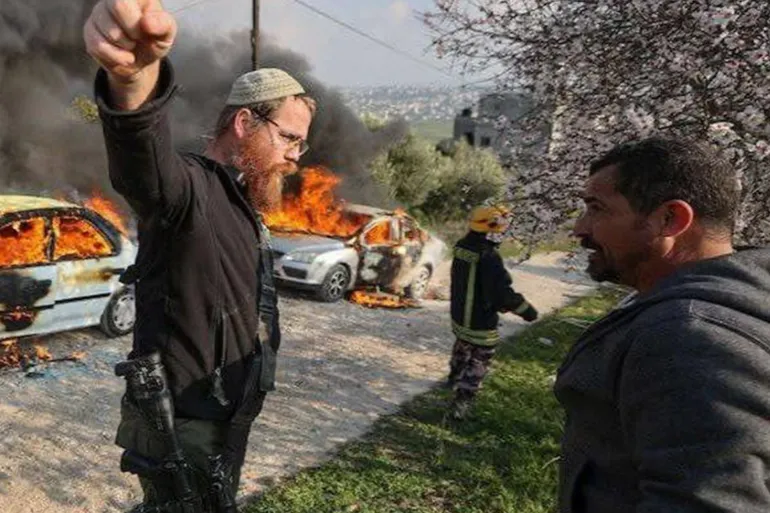
Settlement expansion has been accompanied by increased settler violence and attacks, with over 1,800 incidents documented in 2025, according to the UN.

Settlers have been involved in the killings of Palestinians, including children, and have caused thousands of injuries through physical assaults, shootings, and arson.

In the first weeks of 2026, the UN Office for the Coordination of Humanitarian Affairs (OCHA) recorded at least 55 settler attacks causing injury or property damage and injuring 30 Palestinians. These attacks, often targeted water systems and schools, have directly led to the displacement of over 100 Palestinian Bedouin and herding households.

In the Jericho area community of Ras ‘Ein al ‘Auja, at least 77 households began dismantling their homes following intensified nighttime settler attacks and threats.

Settler attacks have completely displaced 29 Palestinian communities since October 2023, more than one a month on average, UN data showed.

Attacks frequently target Palestinian property, including the burning of homes, destruction of vehicles , poisoning water sources , steeling livestock , devastating agricultural livelihoods and uprooting or chain sawing of olive trees.

Settler violence is a key driver of forced displacement, creating a coercive environment that has forced dozens of Palestinian communities to leave their homes.

Since October 7, 2023, thousands of Palestinians have been displaced due to settler attacks.

The Office of the United Nations High Commissioner for Human Rights (OHCHR) and various UN bodies have reported that the distinction between settler violence and state violence has become increasingly blurred, with settlers wearing uniforms and acting alongside or as part of the Israeli security forces.

The line between settler and state violence has blurred “to a vanishing point,” according to a 2025 UN report.

This is attributed to the involvement of settlers in official “settlement defense squads” and “regional defense battalions,” which are part of the Israeli army’s structure.

The UN has noted a high level of impunity for perpetrators, with very few investigations into settler attacks resulting in convictions.

The European Union, various international bodies, various nations, including the UK, Canada, and Germany, have urged Israel to halt these activities, citing that the settlements are obstacles to peace , illegal under international law and undermine the possibility of a two-state solution.

The UN human rights office has repeatedly called on Israeli authorities to protect Palestinians from these attacks, end the cycle of violence, and hold perpetrators accountable.

However as of January 2026, reports indicate that Israel is disregarding all condemnations and warnings and accelerating its actions in the occupied West Bank, shifting from a “slow creep” of control to a rapid expansion of settlements and infrastructure, which observers characterize as de facto annexation.

This, combined with increased settler violence and military actions, is profoundly altering the landscape of the West Bank.

This ongoing process, which was often referred to as “creeping annexation’’, and now some analysts call it “running annexation’’ aims to permanently incorporate the West Bank into Israel by creating irreversible, on-the-ground facts.

Najla M Shahwan contributed this article to the Jordan Times

Continue reading
Israel’s ‘New Battle’ With Hamas

CROSSFIREARABIA – Now the remains of Ran Gvili, the last Israeli hostage in Gaza recovered, many thought Israel would move to open the borders and quickly allow for the rebuilding of the enclave.

But not so. Israeli Prime Minister Benjamin Netanyahu now says before that can happen Hamas must disarm and dismantle itself. He says if the Islamic movement doesn’t give up its arms voluntarily it will be forced to, no less by Israel and its army. 

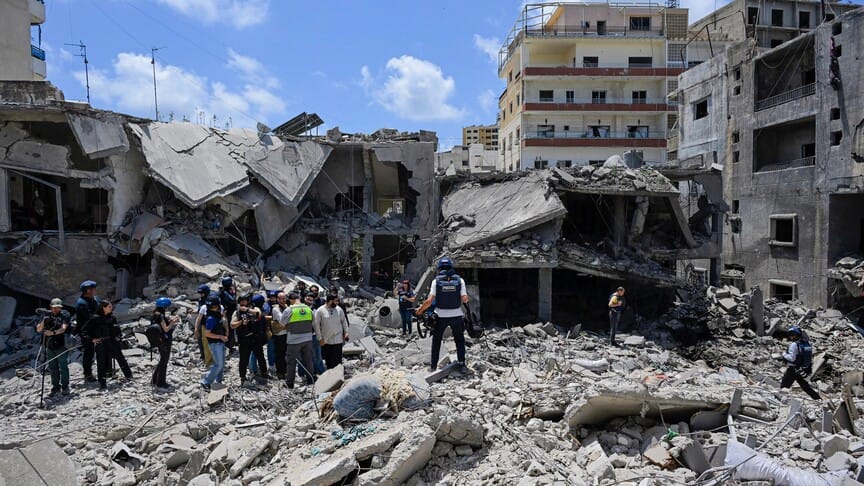
But this is laughable. Netanyahu has been consistently saying throughout this genocide that his army is moving towards destroying the movement and its army of fighters and operatives. Instead, Israel destroyed the whole of Gaza, turning the strip into a huge rubble and debris site.

The only thing that Israeli couldn’t do was to destroy the Palestinian resistance, Hamas and the other different factions. Hamas and its fighting forces is said to be alive and kicking according to different  estimates including the Americans but Israeli intelligence currently put the Hamas fighters at 20,000. 

This must be depressing for Netanyahu who spent over $66 billion on trying to defeat Hamas. All he did however is massively destroy the enclave creating around 60 million tons of debris and wreckage according to UN estimates and killing 71,000 civilians while 10,000 remaining buried underground. 

For all his bombast about slowly destroying Hamas, Netanyahu did nothing of the sort. While he may have killed some of its top leaders like Ismael Haniyah and Yehiya Sinwar who died in direct battlefield combat and not in an underground bunker away from his men as the Israelis like to claim, fighters are being replenished from human mass in Gaza whose population is estimated at around 2 million people.

Based on commentary from Israel’s Channel 13 Netanyahu has provided  US President Donald Trump with Israeli military intelligence to say that Hamas still has 60,000 kalashnikovs inside the Gaza Strip. These are yet to be destroyed. 

While Netanyahu may have provided the figures for political reasons, it maybe travesty on his part because it shows that despite the mass Israeli massacres in two years of war against the Gaza Strip, Tel Aviv is not able to get rid of Hamas nor of the other Palestinian resistance groups.

Kalashnikovs are not the only weapons. While intelligence estimation suggests that long and short-missiles may have been heavily reduced, Hamas still has thousands of rockets in its stockpiles and is still an effective fighting force despite the fact that Israel, in its “yellow line” still controls more than 53 percent of the Gaza Strip.

Now under Stage II of Trump’s peace accord on Gaza, Hamas is supposed to give its weapons to the Palestinian Authority, but Israel is fearful this may not happen and are on military alert and are still trigger-happy having killed 490 people since the ceasefire was killed on 10 October, 2025.

But these weapons frequently fall into the hands of the resistance as it is estimated that 15 percent of the weapons, missiles, bombs and mortar fired onto the different parts of Gaza don’t go off. What tended to happen in the past two years is that these would fall into the hands of the Hamas fighters, “repackaged” and fired back at Israeli soldiers and cities. Some may off course stay in the Hamas stockpiles.

What this means is the fight between Israel and Hamas will continue despite the Trump peace machinations. A bit of good news maybe coming out of that as Israel, under pressure from the White House, has promised to open the crucial southern Rafah Crossing between Gaza and Eygpt. While Israel has been resisting this, it has finally agreed to open the border both ways so that people can go in and out of Gaza. The short-coming of that is that Israel is refusing to allow the entry of aid trucks for the starved enclave.

Continue reading