Iran Strikes Israel 200 Times on Day 1 of War

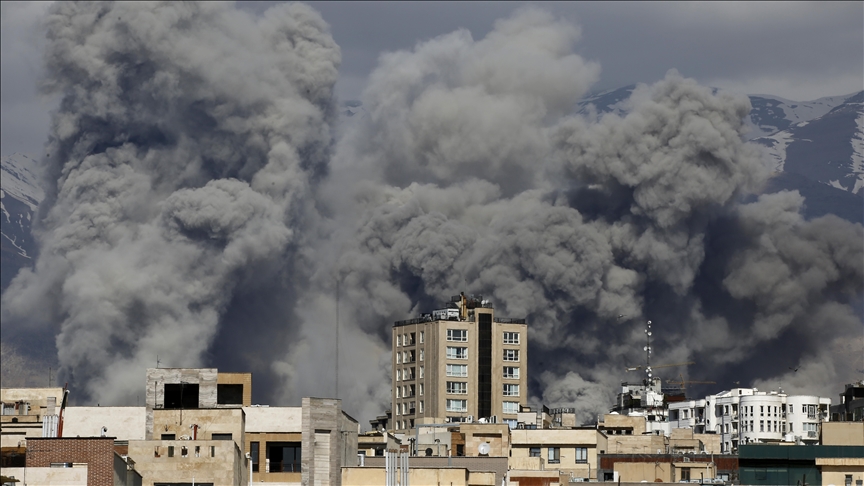
Israeli emergancy services stated, Saturday night, 89 people were injured as a result of the Iranian attacks while the Hebrew media (Channel 13) reported that Tehran launched more than 200 strikes on the different parts of the Jewish entity on the first day of the US-Israeli war launched on Iran. The Israeli media (Channel 12) reported that central Israel suffered much material damage from the Israeli missiles that launched on Israel despite the fact tenss of these were deflected by Israeli batteries. Yedioth Ahronoth reported injuries in the city of Bnei Brak, near Tel Aviv though it didn’t say how critical these were. The Hebrew Channel 12 reported the number of fires were caused in northern Israel. Air raid sirens were reported in many parts of the country as ringing all day because of the incoming missiles with millions of Israelis taking to underground shelters.

Continue reading
UN Condemns US/Israel Attacks on Iran

UN Secretary-General António Guterres and the heads of UN agencies have condemned Saturday’s joint Israeli and US attacks on Iran and the Iranian retaliatory strikes on Israel and the Gulf Regions.

The attack on Iran reportedly targeted military sites as well as the leadership of the Iranian regime. Explosions were heard in Israel and Gulf countries after Iran launched a wave of drones and missiles.

Mr. Guterres declared that the military escalation in the region undermines international peace and security, and recalled that all Member States must “respect their obligations under international law, including the Charter of the United Nations,” which prohibits “the threat of the use of force against the territorial integrity or political independence of any state, or in any other manner inconsistent with the Purposes of the United Nations.”

 The UN Chief called for an immediate cessation of hostilities and de-escalation and warned that a failure to do so risks a wider regional conflict with grave consequences for civilians and regional stability. 

Risk of ‘destruction on an unimaginable scale’

Senior officials added their own responses on Saturday morning: Volker Türk, the High Commissioner for Human Rights said that bombs and missiles are not the way to resolve differences but “only result in death, destruction and human misery.” Civilians, he noted, “end up paying the ultimate price.”

Mr. Türk called for all parties to return to negotiations in order to avoid a wider conflict that would mean further civilian deaths and “destruction on a potentially unimaginable scale, not just in Iran but across the Middle East region.”

World Health Organization (WHO) Director-General Tedros Adhanom Ghebreyesus said in a statement that he was deeply troubled by the situation and urged leaders to “choose the challenging path of dialogue over the senseless route of destruction.” 

Emergency Security Council meeting scheduled

Security Council meeting to discuss the attacks has been called by French President Emmanuel Macron. The meeting is scheduled for 4PM Eastern Time on Saturday.

Follow the meeting live on UN News and on UN WebTV

Reactions from across the UN system

  • António Guterres, UN Secretary-General“I condemn today’s military escalation in the Middle East. The use of force by the United States & Israel against Iran, and the subsequent retaliation by Iran across the region, undermine international peace & security.”
  • Tedros Ghebreyesus, Director-General, World Health Organization (WHO)“I am deeply concerned about the current situation in the Middle East. My heart is with the civilians caught in the crossfire.”
  • Volker Türk, High Commissioner of Human Rights“As always, in any armed conflict, it is civilians who end up paying the ultimate price.”
  • Annalena Baerbock, President of the General Assembly“The UN Charter is clear: all Member States must settle their international disputes by peaceful means in such a manner that international peace and security, and justice, are not endangered.”
  • International Atomic Energy Agency“The IAEA is closely monitoring developments in the Middle East, and urges restraint to avoid any nuclear safety risks to people in the region.” – UN News

Continue reading
Who is The ‘True’ Terrorist Here?!

By Mohammad Abu Rumman

“This is not a geopolitical battle; it is a spiritual battle. A battle of the ages. It is not horizontal. It is not left or right, liberal or conservative. It is a vertical battle… a battle of heaven against hell, good against evil. People must see it in this context, or they will completely fail to understand it.”

With these words, Mike Huckabee, the U.S. ambassador to Israel, described the ongoing war of extermination in Gaza during an interview with NBC. He criticized the move by several European states to recognize Palestine at the United Nations this month, adding: “You do not stand with Israel merely because you agree with its government… but because it defends the traditions of Abraham, Isaac, and Jacob.”

This rhetoric aligns seamlessly with statements made by members of Netanyahu’s government. Finance Minister Bezalel Smotrich, for example, openly called for the “complete destruction of Gaza” and the forced displacement of its residents to other countries, invoking biblical injunctions about “erasing the memory of Israel’s enemies.” What is striking is that such discourse is no longer viewed as fringe or shocking in Western and global media and political circles. It has become commonplace—voiced by ministers, politicians, and even Netanyahu himself—steeped in extremism and religious absolutism toward “the other.” In this case, the “other” is the Palestinians as a whole, along with anyone who dares oppose the Israeli far right.

Here, the urgent question arises: how should terrorism and extremism be redefined today? Who is the true terrorist? And what form of terrorism most threatens regional security and societal peace?

Following the September 11 attacks in 2001, the United States declared its “war on terror,” rallying dozens of states against al-Qaeda and later ISIS. ISIS was undeniably a brutal extremist group that committed massacres, established a so-called caliphate, and tore down borders between Syria and Iraq. Yet it remained an isolated, besieged organization—globally reviled, stripped of legitimacy, and unsupported by institutions or states. What we witness today, by contrast, is state terrorism practiced openly, backed by major powers, and legitimized through religious rhetoric presented as divine will. The irony is palpable: Israel engages in territorial expansion, rejects recognized borders, launches cross-border military strikes, and has a prime minister who frames his mission in explicitly spiritual and historic terms—the realization of Greater Israel.

Skeptics may argue that labeling Israel a terrorist state changes nothing; it clashes with power dynamics and U.S. strategic interests. Perhaps. Yet it remains essential to reshape Arab, Islamic—and indeed universal—awareness of these realities, and to recalibrate the very language and definitions we use. These should form part of today’s Arab political, media, and diplomatic discourse. If an international coalition against terrorism is to exist, the actor most deserving of that designation is Israel’s government—not transient groups like ISIS or al-Qaeda. Huckabee’s words and the declarations of Netanyahu’s ministers are not aberrations; they are clear manifestations of this reality: state terrorism, sanctified by religion and legitimized internationally. If there is a rogue state whose leaders should stand before the International Criminal Court for genocide and mass killings, it is Israel.

This framing is of enormous significance for international, regional, and even domestic debates. Otherwise, Arab political and intellectual circles will continue to be dragged along by narratives that consistently place the blame on extremist movements emerging here or there—movements that are, in truth, the predictable outcomes of political dysfunction. Whether born of Israeli aggression or Arab authoritarianism, such groups are less causes than consequences. To blame them alone is to misread the sequence of cause and effect.

Today, amid the genocidal war on Gaza, a new political generation is coming of age. It witnesses, daily and directly, the starvation, slaughter, and devastation visited upon children, women, and civilians. It also sees the deafening global silence, alongside Arab paralysis and strategic impotence. What reactions can we reasonably expect from such a generation? This is not an attempt at justification, but rather an explanation of what is taking shape: a coming wave of anger among youth, or a wave that others may channel into particular political or religious agendas. That wave is already being born—out of the crucible of Gaza.

The writer is a columnist in The Jordan Times

Continue reading
US Police Arrest Israeli Official in Underage Sex Scandal

Las Vegas police, working with the FBI, Homeland Security, and Nevada’s Internet Crimes Against Children Task Force, announced the arrest of eight men on Wednesday. One of them was Tom Artiom Alexandrovich, 38, a top Israeli cyberwarfare official.

Alexandrovich works directly under Prime Minister Benjamin Netanyahu. He serves as Acting Head of Data & AI at Israel’s National Cyber Directorate. His job safeguards Israel’s critical infrastructure, including power grids, airports, and sensitive intelligence networks.

According to Las Vegas authorities, Alexandrovich and others were charged with luring a child with a computer for a sexual act. In Nevada, this felony carries a sentence of up to 20 years in prison.

Alexandrovich is the founder of Israel’s multi-million-dollar “Cyber Dome” initiative. The program uses AI to detect, neutralize, and repel cyber threats before they reach critical systems. He has deep access to Israel’s cyber secrets and classified partnerships with foreign powers.

His position makes him one of Israel’s most powerful cyber officials. Experts say any ally, including the United States, would normally monitor such a figure closely. He was in Las Vegas for a professional conference, not as a registered diplomat. He has no diplomatic immunity. Yet U.S. authorities allowed him to board a plane and return to Israel within days, without trial, bail conditions, or public explanation

Israeli outlet Ynet reported only that Alexandrovich was “briefly detained for questioning… before his release and return to Israel.” The report did not mention the felony charges or the multi-agency child predator sting led by US authorities according to the Quds News Network.

Continue reading